
Software and AI Public-Sector Demand: How to Spot Agency and Funded Buyer Signals
A practical guide for turning official technology, acquisition, spending, and program records into qualified software and AI sales paths.
Quick answer
The short answer
Public-sector software demand rarely arrives labeled with a commercial product category. An agency may describe a case backlog, cybersecurity requirement, data-sharing problem, acquisition forecast, or service-modernization goal instead. Software and AI companies need to translate those official signals into a specific buyer problem, then decide whether the realistic route is an agency sale, a prime partnership, a funded-recipient sale, an early market-research response, or monitoring. This guide shows how to build that evidence without treating every technology mention as an active opportunity.
Key takeaways
- Translate the product into mission workflows and operating problems before searching public records.
- Separate active procurement, acquisition planning, historical spending, policy, and funded-recipient evidence.
- For AI, evaluate data rights, security, testing, interoperability, and ongoing monitoring before calling a record a fit.
- Every qualified signal needs a target, revenue motion, contact path, and owned next action.
Start with the public-sector job, not the software label
A commercial category such as workflow automation, vertical SaaS, analytics, or generative AI may never appear in the record. Public buyers more often describe the job: reduce claims-processing time, secure endpoints, manage inspections, improve constituent access, detect improper payments, share data across programs, or replace a legacy system. Build search language from those jobs, the users doing them, and the records they handle.
The federal acquisition system reinforces this problem-first approach. FAR Part 10 requires market research appropriate to the circumstances, including the availability of commercial products and services. A Sources Sought notice or request for information can therefore be evidence that an agency is learning what the market can provide. It is not automatically a solicitation, and a response is not an offer or an implied future award.
Create a translation sheet before collecting records: capability, mission problem, likely office, data, integration boundary, security condition, and disqualifier. Reject requirements that depend on certifications, hosting, performance history, or integrations the company cannot support.
Use five evidence lanes without mixing their meaning
SAM.gov contract opportunities are the active and pre-award lane. Preserve the notice type, status, response date, office, set-aside, NAICS code, attachments, place of performance, and official contact. A solicitation may support Sell to Agency. Sources Sought may support an early capability response. An award notice is historical evidence and may reveal an incumbent or partner, but it should not remain in an active-bid lane.
USAspending.gov is the historical money-flow lane. Its contract and assistance records can identify agencies, recipients, award types, incumbents, and places of performance. Use that evidence to test whether a buyer has purchased adjacent technology or whether a funded organization may need implementation help. Do not claim that an old obligation is an available budget, an open requirement, or proof that the same buyer will purchase again.
Agency procurement forecasts and business-opportunity pages are the planning lane. Acquisition.gov links to agency forecasts and vendor-communication resources. A forecast can justify Research Only, Monitor Policy, or early small-business-office research, but dates and acquisition strategies can change. Grants.gov and agency award announcements form a separate funded-program lane: first validate eligibility and status, then distinguish Direct Apply from selling to a future recipient.
Treat AI acquisition as a lifecycle commitment
OMB Memorandum M-25-22 directs federal agencies to address requirements across the AI acquisition lifecycle, including performance and effectiveness, data ownership and portability, privacy, security, interoperability, vendor lock-in, ongoing testing, and monitoring. Those requirements turn broad AI enthusiasm into concrete qualification questions for a vendor.
A strong fit statement should therefore name the workflow, authoritative source, user group, decision boundary, and control environment. It should explain what the system assists with, what remains under human authority, how performance can be evaluated, and how data can be exported or transferred. A generic claim that a model makes government more efficient does not establish acquisition fit.
Security creates another route test. CISA's Secure by Design guidance places responsibility on technology manufacturers to make products secure by default and reduce avoidable customer burden. For a sales team, this means the action row should surface the relevant deployment model, identity controls, logging, vulnerability process, data handling, and known compliance gaps before outreach advances.
Choose the revenue motion from the record
Use Sell to Agency when an agency or public entity has a credible buying route and the company can perform. Use Channel / Distributor Motion when a contract vehicle holder, reseller, systems integrator, or prime is the practical route. Use Sell to Funded Buyer when an official award identifies a recipient with a plausible implementation need. Use Monitor Policy when guidance or regulation may change demand but no buyer or funded target is yet supported.
Direct Apply is comparatively narrow for commercial software companies. A grant search result is not enough; the notice's eligibility section and application instructions control. When a company is ineligible, preserve the program as context only if there is a credible downstream route to a named recipient after awards are announced. Never label a prospective applicant as funded.
The contact path follows the motion. Active procurements route through the notice contact and contracting office. Forecasts may route to the listed acquisition office, vendor-engagement event, or small-business office after research. Prime and recipient paths may justify role-based account research and selective enrichment. Policy records usually create a monitoring owner and review date, not a cold-email task.
Build a software opportunity action row
A useful row records the official source and retrieval date; notice or award status; target organization and office; mission problem; product-to-workflow fit; revenue motion; security, data, integration, and eligibility conditions; contact route; owner; next action; and disqualifier. Keep evidence in the row so a seller does not have to reconstruct the research before acting.
An illustrative example: a Sources Sought notice asks about commercial tools for reviewing a defined document type. The row is not 'AI contract.' It is an early Sell to Agency research signal. The target is the issuing office, the contact path is the official response route, and the next action is to review attachments against supported formats, accuracy evaluation, hosting, security, and timeline. No response, meeting, solicitation, or award is assumed.
Another illustrative example: USAspending shows repeated modernization awards to a systems integrator at a relevant agency. The row may become Channel / Distributor Motion or Research Only. The next action is to verify current vehicles, active forecasts, incumbent scope, and a specific complementary capability before partner outreach. Historical awards support market mapping; they do not prove that the prime is seeking a vendor.
Run a focused 30-day software market test
In week one, select two existing offers and translate them into mission workflows, user roles, agency language, likely NAICS and product-service codes, security boundaries, and exclusions. Define what evidence would justify continuing. In week two, collect a small set across SAM.gov, USAspending, forecasts, and relevant program or policy sources while keeping each lane labeled.
In week three, reject expired timing, generic AI mentions, unsupported deployment requirements, failed eligibility, and records without a credible target or acquisition route. Give each retained row one motion and one action.
In week four, invest further when a workflow problem repeats across official records, the company can meet likely controls, and owners can execute the routes. Narrow or pause when evidence depends on weak keywords, inaccessible data, unrealistic integration, or an unsupported procurement path.
Avoid the signals that create false pipeline
Do not count a technology strategy as a purchase, an RFI as a solicitation, an award as available budget, a grant applicant as a recipient, or a policy announcement as a buyer. Do not infer a personal contact when an official contracting route controls communication.
Software and AI signal qualification checklist
- 1Name the mission workflow and user problem, not only the software category.
- 2Label the record as active procurement, planning, historical spending, funded program, or policy evidence.
- 3Preserve notice type, status, dates, office, attachments, and official contact.
- 4Check data rights, portability, privacy, security, testing, interoperability, and lock-in conditions.
- 5Verify eligibility before using Direct Apply.
- 6Choose one allowed revenue motion and one credible target.
- 7Route agency communication through official source and procurement paths.
- 8Reject generic AI mentions and requirements outside the company's operating capacity.
- 9Assign an owner, next action, review date, and explicit disqualifier.
- 10Keep historical awards and forecasts out of the active-opportunity count.
Charts and visual evidence
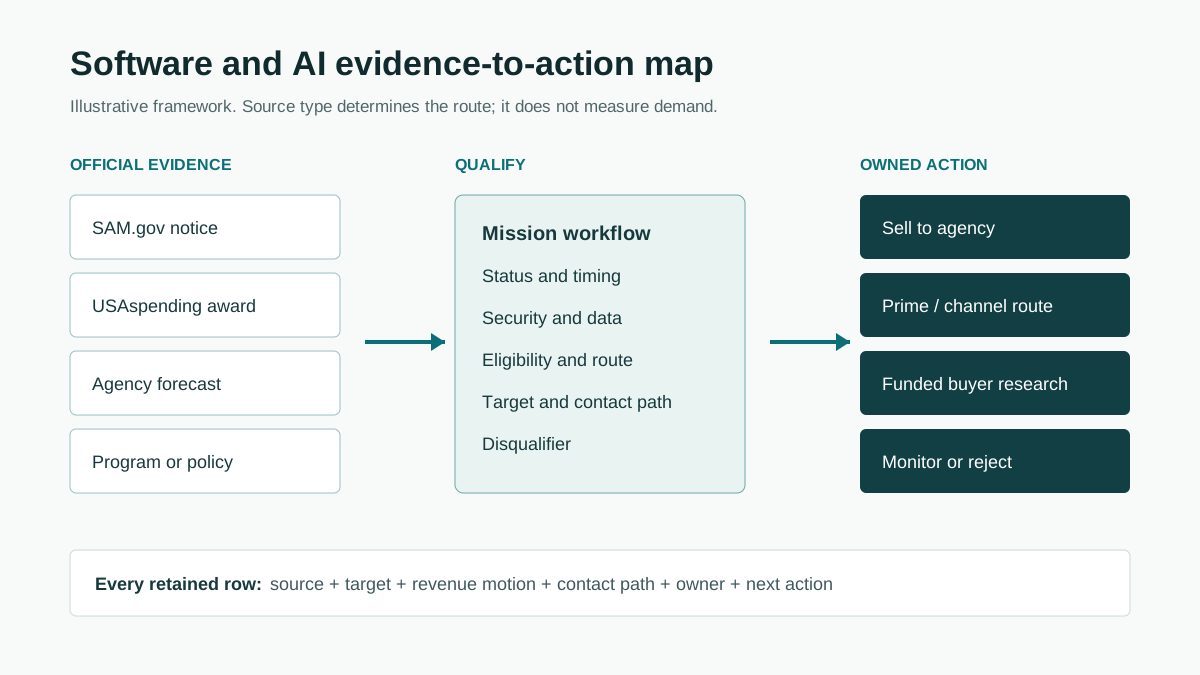
Software and AI evidence-to-action map
The same technology capability can create different actions depending on whether the evidence is a notice, award, forecast, funded program, or policy record.
Open visual full sizeIllustrative framework; it does not show measured demand or conversion results. Source: Illustrative Opportunity Scanner framework based on FAR Part 10, SAM.gov, USAspending.gov, Grants.gov, and OMB M-25-22
Sources cited
Put this into the product
Run a free scan to turn your software or AI capabilities and official public records into qualified targets, revenue motions, contact paths, and next actions.
Opportunity Scanner classifies the evidence, opens the official route, and lets you start a pursuit with an owner, fit decision, next step, internal due date, and notes.
Scan Your Company WebsiteKeep exploring
Related reads
Industry Guides
Infrastructure Opportunities for Construction Companies
A source-backed workflow for finding infrastructure projects, public owners, funded recipients, primes, subcontracting routes, and supplier demand.
7 min read
Industry Guides
Clean Energy Public-Sector Opportunities
How clean-energy and facilities companies can distinguish grants, rebates, procurement, policy, funded buyers, and implementation routes.
7 min read
Industry Guides
Manufacturing and Supply Chain Public-Sector Demand
A practical source-to-action guide for manufacturers, suppliers, logistics providers, and industrial service companies pursuing public-sector demand.
7 min read