
Why Government Spending Is an Overlooked Growth Channel for Businesses
A practical guide to using contracts, awards, grants, recipients, and forecasts as evidence for new public-sector revenue paths.
Quick answer
The short answer
Government spending is easy to dismiss as a specialized market for experienced contractors. That view misses the larger business-development value of public records. An official notice can reveal an active agency need. Historical awards can identify recurring buyers and incumbent vendors. Grants can create funded organizations that later purchase products and services. Forecasts can show demand before a solicitation exists. The opportunity is not the size of government spending in the abstract. It is the ability to find a relevant source, identify the organization positioned to buy or deliver, choose the right revenue motion, and assign a next action before competitors notice the same evidence.
Key takeaways
- Government spending records are market evidence first; fit, timing, eligibility, and a credible route determine whether they become pipeline.
- Active notices, historical awards, grant opportunities, funded recipients, and forecasts must stay in separate lanes because they support different actions.
- Commercial companies can sell to agencies, funded buyers, award recipients, or primes without treating every record as a direct bid or grant application.
- A useful signal ends as an owned action row: source, target, revenue motion, contact path, next action, and disqualifier.
Government spending is evidence of a market, not proof of a sale
The federal contracting market is large enough to deserve attention, but a large topline does not prove fit for any one company. The U.S. Small Business Administration reported that small businesses received $183.5 billion in federal prime contracting dollars in fiscal year 2024, equal to 28.76 percent of eligible federal contract dollars. That figure covers one federal contracting market in one year. It is not total public spending, an addressable-market estimate, or a promise that a particular company can win work.
The useful question is narrower: do public organizations repeatedly buy, fund, or plan work adjacent to what the company already delivers? SBA advises businesses to research whether government buys what they sell, how large that market appears to be, and which agencies buy it. USAspending and agency procurement forecasts are among the official sources SBA recommends for that research.
This evidence can support a go or no-go decision before a team spends heavily on registrations, consultants, certifications, or capture tools. One weak keyword match should not create a new sales strategy. Repeated, current, source-backed demand across a defined buyer set may justify deeper investment.
Use five evidence lanes without blending them together
An active procurement notice is the most time-sensitive lane. SAM.gov publishes federal contract opportunities, but notice type controls the action. A solicitation may support a bid review. A Sources Sought notice or request for information may support a capability response or market-research conversation. An award notice is historical evidence. A special notice may announce an event or provide context. Calling all of them open contracts creates false urgency.
Historical spending is a different lane. USAspending covers contracts, grants, loans, and other federal financial assistance. It can reveal agencies, recipients, incumbents, award types, places of performance, and patterns over time. USAspending defines an award as money the federal government has promised to pay a recipient. That is strong money-flow evidence, but it does not prove that a new purchase is open or that an award recipient needs a specific vendor now.
Grant opportunities form a third lane. Grants.gov distinguishes forecasted, posted, closed, and archived records. Posted means the funding opportunity is accepting applications; forecasted means it is planned but not guaranteed to become an official announcement. Eligibility belongs to the specific notice. An ineligible company should not label a grant Direct Apply simply because the topic fits its product.
Funded recipients form a fourth lane. A nonprofit, university, state agency, local government, health provider, or commercial organization that receives public funds may later need implementation partners, technology, supplies, staffing, training, or specialized services. The award establishes the recipient and funded purpose. A sales team still needs to validate timing, scope, purchasing authority, and a plausible need before calling that recipient a buyer.
Procurement and program forecasts form the fifth lane. Acquisition.gov links to agency forecasts that can reveal anticipated requirements before a formal solicitation. These records can justify monitoring, account research, or an appropriate early contact route. They are planning signals, not active solicitations or promises that an acquisition will occur.
Choose the revenue motion from the evidence
The same company may have several valid public-sector revenue motions. Sell to Agency fits when a public office is the likely buyer and the company can follow its procurement route. Direct Apply fits only when an official funding notice is open and the company is plausibly eligible. Sell to Funded Buyer or Sell to Award Recipient fits when a named organization controls funds or delivery and may purchase complementary support.
Partner with Recipient fits when the company adds a capability the applicant or awardee needs but should not claim the funding itself. Channel or Distributor Motion fits when a prime, reseller, distributor, or implementation partner is the realistic route into the market. Monitor Policy fits when a rule, budget, plan, or forecast could create future demand but does not yet support outreach. Research Only is the honest classification when evidence is useful but incomplete.
SBA distinguishes prime contractors, which work directly with government, from subcontractors, which work for other contractors. Subcontracting can create a practical entry path for a company that is not ready to perform as a prime. It still requires a real fit, a credible prime or vendor route, and attention to the requirements of the specific work.
Build an Opportunity Action Table instead of a bookmark folder
A portal link is not pipeline. Each retained record should preserve the official source URL, source date, record status, evidence summary, target organization, revenue motion, contact path, next action, owner, due date when relevant, and a disqualifier. These fields turn public information into work that a sales, partnerships, or strategy team can review consistently.
Contact path should follow the signal. An active notice may route to its source-native contracting contact and response instructions. A forecast may route to an agency small-business office, program office, or monitoring task. A historical award may route to research on the buying office or incumbent. A funded recipient may route to a program, operations, partnerships, or procurement role after the recipient and award purpose are verified.
The next action should reduce uncertainty rather than jump directly to outreach. Review the attachments. Confirm eligibility. Check whether the deadline is realistic. Validate the recipient. Compare historical awards. Find the official vendor registration page. Identify an incumbent prime. Schedule a forecast review. A row should not enter active pipeline until the action and owner are clear.
Use a conservative qualification test
Keep a signal when the source is authoritative, the record is current enough for the decision, the evidence maps to an existing offer, the target is identifiable, and at least one lawful and realistic route exists. Give higher priority to records with a clear deadline, named office, repeated demand, verified recipient, or source-native contact path.
Reject or defer records with weak semantic fit, expired timing and no market value, failed eligibility, requirements beyond the company's capacity, no credible target, or no action other than generic cold outreach. A truthful zero-match result protects the team's time and the credibility of the report.
Illustrative example: a commercial training company finds a posted grant limited to workforce boards. The source is active, but the company is not a Direct Apply target. The better row may be Partner with Recipient research, with a next action to monitor official award announcements and assess whether a future recipient needs delivery support. No recipient, response, meeting, or revenue outcome should be assumed.
Government spending signal qualification checklist
- 1Preserve the official source URL and source date.
- 2Classify the record as active, historical, forecasted, funded-recipient, policy, or research evidence.
- 3Write the specific connection to an offer the company already delivers.
- 4Name the agency, office, recipient, prime, partner, or other plausible target.
- 5Assign exactly one primary revenue motion.
- 6Choose an official or role-based contact path that matches the signal.
- 7Assign one next action that reduces uncertainty and one owner.
- 8Record the deadline, monitoring date, or reason timing is unknown.
- 9State the clearest disqualifier before the row enters active pipeline.
- 10Reject records that remain interesting but cannot become credible action.
Charts and visual evidence
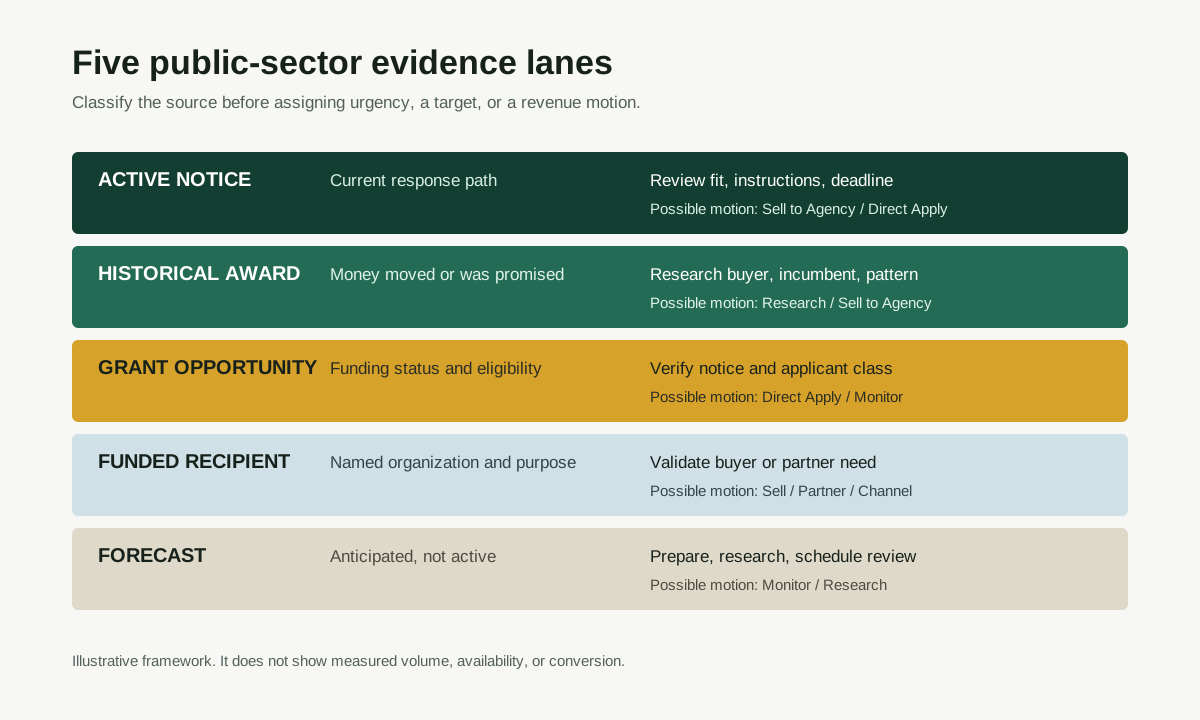
Five public-sector evidence lanes
The source lane determines what the record proves, who the target may be, and which action is defensible.
Open visual full sizeIllustrative classification framework. It does not show measured opportunity volume or conversion. Source: Illustrative Opportunity Scanner framework based on official SAM.gov, USAspending.gov, Grants.gov, and Acquisition.gov source definitions
Sources cited
Put this into the product
Run a free scan to see which official spending signals map to your company, then review the target, revenue motion, contact path, and next action for each qualified row.
Opportunity Scanner classifies the evidence, opens the official route, and lets you start a pursuit with an owner, fit decision, next step, internal due date, and notes.
Scan Your Company WebsiteKeep exploring
Related reads
Public-Sector Sales
How to Build a Public-Sector Sales Pipeline Without a GovCon Team
A practical 30-day market test for companies that want to validate public-sector demand before hiring a capture team.
10 min read
Public-Sector Sales
Public-Sector Deal Flow for Commercial Companies
A practical system for turning official public-sector records into qualified commercial deal flow, owned actions, and honest stop decisions.
8 min read
Public-Sector Sales
How to Use Sample Opportunity Reports to Plan Public-Sector Outreach
Use industry sample reports to evaluate public-sector fit, understand opportunity evidence, and plan more relevant outreach.
6 min read