
Manufacturing and Supply Chain Public-Sector Demand
A practical source-to-action guide for manufacturers, suppliers, logistics providers, and industrial service companies pursuing public-sector demand.
Quick answer
The short answer
Public-sector manufacturing demand extends beyond an agency buying a finished product. It can flow through prime contractors, domestic supply-chain initiatives, Manufacturing Extension Partnership centers, economic-development recipients, workforce intermediaries, transportation and emergency programs, and facilities operators. The challenge is deciding whether a record supports a current agency sale, a supplier route, a funded-buyer target, a technical-assistance relationship, or only market context.
Key takeaways
- Map the product, process, capacity, certifications, geography, and industrial codes before searching.
- Use active notices for procurement, award data for market evidence, and program records for recipient or partner research.
- Prime and supplier routes require scope, onboarding, quality, cybersecurity, and domestic-source qualification.
- Workforce and economic-development funding should identify verified intermediaries and recipients, not be counted as manufacturing purchase orders.
Define the industrial capability precisely
Manufacturing searches become noisy when the company is described only as a manufacturer. Record the finished products, components, materials, processes, tolerances, equipment, certifications, production capacity, minimum runs, lead times, logistics radius, quality systems, and restricted markets. Map likely NAICS and product-service codes, but verify them against actual work rather than choosing broad labels for visibility.
The same capability can fit several targets. An agency may buy the item directly. A prime may need a qualified supplier. A grant recipient may need production equipment or technical services. An MEP Center may provide assistance or convene manufacturers rather than purchase the company's output. Each target requires a separate evidence and contact path.
Build disqualifiers early: prohibited materials, unsupported tolerances, insufficient capacity, unavailable certifications, cybersecurity requirements, domestic-source conditions, unrealistic delivery, or geography. A smaller, technically accurate search produces more usable pipeline than a large set of adjacent keywords.
Combine procurement and historical buyer evidence
SAM.gov is the primary federal notice lane. Preserve notice type, product or service code, NAICS code, set-aside, quantity, delivery location, response date, attachments, office, and official contact. A Sources Sought notice may support a capability response; a solicitation may support Sell to Agency; an award notice belongs in historical evidence.
USAspending can reveal agencies, award descriptions, recipients, primes, and places of performance. Use repeated purchases to map likely buyers and incumbents, not to assert that a requirement is currently open. Review the underlying award and current agency forecast or procurement source before creating a seller task.
SBA's prime and subcontracting guidance provides another route. Some manufacturers will reach federal demand through a large prime, contract vehicle holder, or distributor. The row should name the supported prime or channel evidence, the relevant scope, supplier onboarding route, and the next action. A general list of major contractors is not enough.
Use manufacturing programs as ecosystem evidence
NIST's Manufacturing Extension Partnership is a public-private network focused on small and medium-sized manufacturers, with centers across the states and Puerto Rico. MEP Centers can support technology adoption, supply-chain resilience, workforce, quality, and operational improvement. That makes a center a possible assistance or ecosystem route, not automatically a customer.
NIST also describes manufacturing measurement, quality, production monitoring, cybersecurity, and supply-chain work that helps manufacturers meet demanding customer requirements. Use this context to identify qualification gaps and partner resources. Do not convert a national program description into an active local opportunity without a current center, notice, event, project, or buyer record.
EDA and workforce programs can identify regions, intermediaries, and recipients investing in industrial capacity, innovation, or training. A commercial company must check the notice's eligibility before using Direct Apply. When it is ineligible, an official award may later support Sell to Funded Buyer or Partner with Recipient after the recipient and vendor need are verified.
Qualify supplier readiness and compliance
A supplier path is not only a contact search. Check quality systems, traceability, cybersecurity, export controls where relevant, domestic-content rules, production and surge capacity, insurance, delivery, financial stability, and prime-specific onboarding. Do not claim that a certification is universally required; tie each condition to the notice, customer, program, or supplier portal.
NIST's Cybersecurity Framework 2.0 provides voluntary guidance for managing cybersecurity risk, while specific contracts and defense supply chains may impose separate requirements. The action row should say which requirement is sourced, which evidence the company has, and which gap needs expert review before pursuit.
Workforce is another capacity condition. DOL apprenticeship and workforce resources can identify training systems and intermediaries, but a labor-market program is not proof that a particular plant is hiring a vendor. Use current awards, local board plans, employer partnerships, or procurements to validate the commercial route.
Build the manufacturing action row
Record the source, retrieval date, target and facility, item or service, industrial codes, quantity or scope when official, buyer or recipient role, notice or award status, incumbent or prime evidence, qualification conditions, revenue motion, contact route, next action, owner, timing, and disqualifier. Preserve attachments and technical references.
Illustrative example: a SAM.gov Sources Sought notice seeks domestic production capacity for a defined component. The row is an early Sell to Agency signal, not a contract. The next action is to compare specifications, capacity, quality, cybersecurity, domestic-source, and response instructions, then decide whether a truthful capability response is possible. No solicitation or award is assumed.
Illustrative example: an EDA award names a regional organization supporting an industrial cluster. The row begins as Research Only. After the recipient publishes an implementation plan or procurement, an equipment, logistics, software, or training company may have a Sell to Funded Buyer or Partner with Recipient route. The award alone does not prove a purchase.
Operate a buyer and supplier map
Review active federal and state notices for current demand, USAspending for historical buyers and primes, agency forecasts for planning, NIST MEP and Manufacturing USA resources for ecosystem and capability context, and official EDA or workforce awards for recipient research. Keep each lane labeled and dated.
Promote rows when technical fit, target, timing, compliance, and route are credible. Assign supplier onboarding, attachment review, capability response, forecast research, recipient validation, or monitoring as the next action. Reject records where the company cannot make or deliver the requirement, the recipient is unverified, or no official commercial route exists.
Opportunity Scanner can structure the evidence and route. It does not establish technical acceptability, responsibility, certification, small-business status, supplier approval, purchase intent, or award probability.
Manufacturing and supply-chain qualification checklist
- 1Define products, processes, materials, tolerances, certifications, capacity, lead times, and geography.
- 2Map accurate NAICS and product-service codes to the supported capability.
- 3Label records as active notice, forecast, historical award, ecosystem program, funded recipient, or workforce context.
- 4Verify the agency, prime, recipient, MEP Center, or intermediary role.
- 5Check specifications, quality, traceability, cybersecurity, domestic-source, delivery, and onboarding conditions.
- 6Choose one target and one allowed revenue motion.
- 7Use the official notice, supplier portal, recipient, or program route.
- 8Assign one owner, next action, timing, and disqualifier.
- 9Keep awards and program context out of active pipeline until a current buying or partner action is supported.
Charts and visual evidence
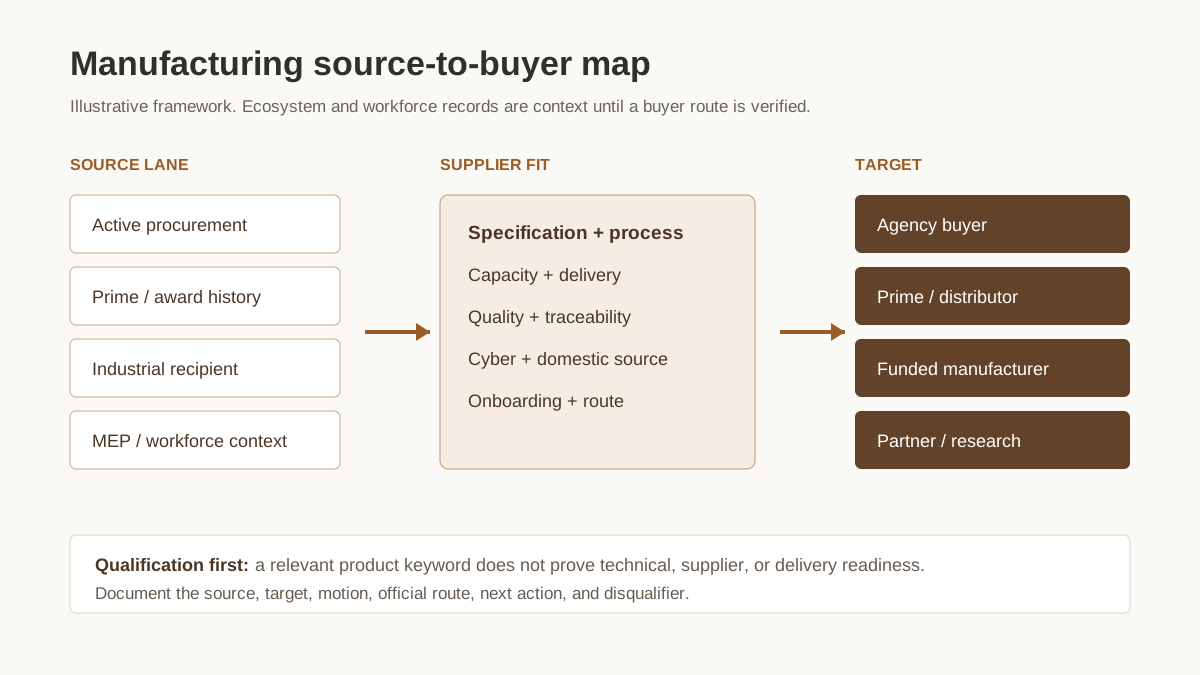
Manufacturing source-to-buyer map
Active notices, prime awards, industrial programs, and workforce records identify different targets and require separate qualification.
Open visual full sizeIllustrative framework; it does not represent measured purchases, supplier demand, or conversion results. Source: Illustrative Opportunity Scanner framework based on SAM.gov, USAspending.gov, NIST MEP, EDA, SBA, and DOL sources
Sources cited
Put this into the product
Run a free scan to turn your manufacturing, supplier, logistics, or industrial-service capabilities into qualified agency, prime, recipient, and partner actions.
Opportunity Scanner classifies the evidence, opens the official route, and lets you start a pursuit with an owner, fit decision, next step, internal due date, and notes.
Scan Your Company WebsiteKeep exploring
Related reads
Industry Guides
Infrastructure Opportunities for Construction Companies
A source-backed workflow for finding infrastructure projects, public owners, funded recipients, primes, subcontracting routes, and supplier demand.
7 min read
Industry Guides
Clean Energy Public-Sector Opportunities
How clean-energy and facilities companies can distinguish grants, rebates, procurement, policy, funded buyers, and implementation routes.
7 min read
Industry Guides
Nonprofit and Community Services Funding Opportunities
A practical guide to separating direct grants, government contracts, funded providers, recipient partnerships, and community-service market evidence.
7 min read