
Can My Business Sell to the Government? A Practical First Check
Use this readiness assessment to decide whether direct agency sales, subcontracting, funded buyers, partnerships, or monitoring fit your business.
Quick answer
The short answer
Most businesses ask whether they can sell to government as if the answer were a single yes or no. The better question is which public-sector route fits the company now. A reliable commercial supplier may be ready to pursue an agency purchase. A specialist firm may fit better behind a prime contractor. A software, training, healthcare, or services company may find faster validation among funded recipients. This assessment helps separate market evidence from contracting readiness so a team can choose a realistic first motion without confusing registration with demand.
Key takeaways
- Readiness combines market fit, delivery capacity, classification, compliance, cash flow, and a credible route to the buyer.
- SAM.gov registration is necessary for direct federal awards, but registration alone does not prove demand or make a company competitive.
- Small-business status depends on the relevant NAICS code and SBA size standard; it is not one universal company label.
- A company that is not prime-ready may still test subcontracting, funded-buyer, recipient-partner, or research motions.
Start with proof that public buyers purchase what you sell
SBA's contracting guide begins with market research. A company should determine whether government buys its products or services, how much demand exists, and which agencies buy. Historical award data in USAspending can reveal prior purchases and incumbents. SAM.gov can reveal current and early-stage notices. Agency forecasts can reveal anticipated demand. None of these sources guarantees a viable pursuit, but together they can answer whether the market deserves a closer look.
Translate the offer into public-sector language before searching. List the buyer problem, deliverables, likely industry classifications, product or service codes when relevant, geography, performance constraints, and terms that should exclude a result. A commercial website may say employee enablement while a public notice says workforce development, technical assistance, instructional services, or program support.
Look for repeated evidence, not one exciting result. Several relevant awards by the same agency, a forecast aligned to the offer, and a current notice with realistic requirements provide a stronger basis than a single broad keyword match.
Assess operational readiness, not just sales interest
Government buyers generally need dependable performance. SBA asks businesses to consider whether they have a record of delivering quality goods or services on time and within budget. A readiness review should cover delivery capacity, staffing, geography, insurance, security or privacy obligations, quality controls, invoicing, cash flow, and the ability to interpret and meet the specific terms of a purchase.
Contract timing can strain a company that expects an ordinary commercial sales cycle. Before pursuing, estimate proposal effort, the cost of compliance, the period between work and payment, and the effect on existing customers. A company can be a strong product fit and still make a rational no-bid decision because the deadline, contract structure, or performance burden is wrong.
For federal small-business opportunities, confirm the NAICS code and current SBA size standard tied to the procurement. SBA size standards vary by industry, often using annual receipts or employee counts, and affiliation rules can affect the calculation. Do not describe a company as small for every procurement based on one code or a general impression.
Choose the route that matches today's readiness
Direct prime sales fit when an agency has relevant demand, the company can perform, and the procurement route is manageable. Active SAM.gov registration allows an entity to bid on federal contracts or apply for federal assistance. SAM.gov is free to use, but activation takes time and registrations require maintenance. Complete it as part of a real pursuit plan, not as a substitute for market validation.
Subcontracting or channel motion may fit when a prime contractor, distributor, or established implementation partner already holds the agency relationship or contract vehicle. SBA explains that subcontractors work for prime contractors rather than directly for government. This can reduce some barriers to direct prime performance, although the company must still meet the prime's and contract's requirements.
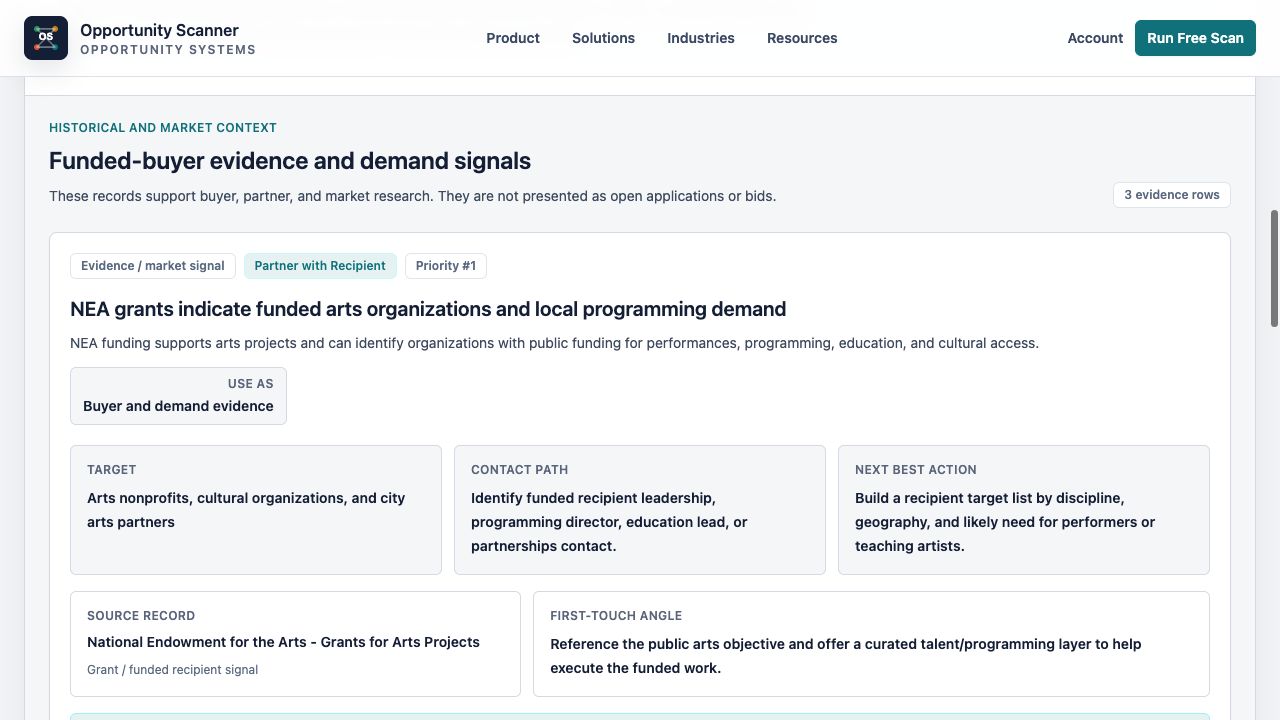
Funded-buyer and recipient-partner motions fit when public money has moved to an organization that may need complementary products or services. The award is evidence of the recipient and purpose, not proof of a purchase. Research the program, timing, role, and procurement path before outreach. Monitor Policy or Research Only fits when the evidence is early, eligibility is unclear, or the route has not been verified.
Make a readiness decision with explicit gates
Use four gates. Market gate: official records show relevant demand. Performance gate: the company can deliver the likely scope, timing, and conditions. Administrative gate: classifications, registration, representations, and required documentation are attainable. Route gate: the team can name the buyer, prime, recipient, office, portal, or adviser that makes the next step concrete.
Pass all four before treating a direct pursuit as active. If market and performance pass but administration does not, create a readiness plan with an owner and date. If market passes but prime performance does not, test a partner or subcontractor route. If only the market gate passes, keep the record in research. If market fit fails repeatedly, stop rather than collecting more portals.
Illustrative example: an equipment supplier finds repeated historical purchases by a federal agency and a relevant procurement forecast. The action row may name the agency as target, Sell to Agency as the motion, the forecast or small-business office as the contact route, and registration plus specification review as next actions. The evidence does not imply that an open solicitation, meeting, or award exists.
Four-gate government sales readiness assessment
- 1Market: official sources show repeated demand for the existing offer.
- 2Market: the likely agencies, funded organizations, primes, or public buyers are identifiable.
- 3Performance: the company can meet likely scope, location, schedule, and quality requirements.
- 4Performance: cash flow and staffing can support the sales and delivery cycle.
- 5Administrative: relevant NAICS codes and size standards have been checked.
- 6Administrative: required registration, documentation, and compliance are attainable.
- 7Route: one realistic revenue motion has been selected.
- 8Route: an official contact, office, portal, prime, recipient role, or adviser is available.
- 9Decision: pursue, prepare, partner, subcontract, monitor, research, or stop.
- 10Owner: assign the next readiness action and review date.
Charts and visual evidence
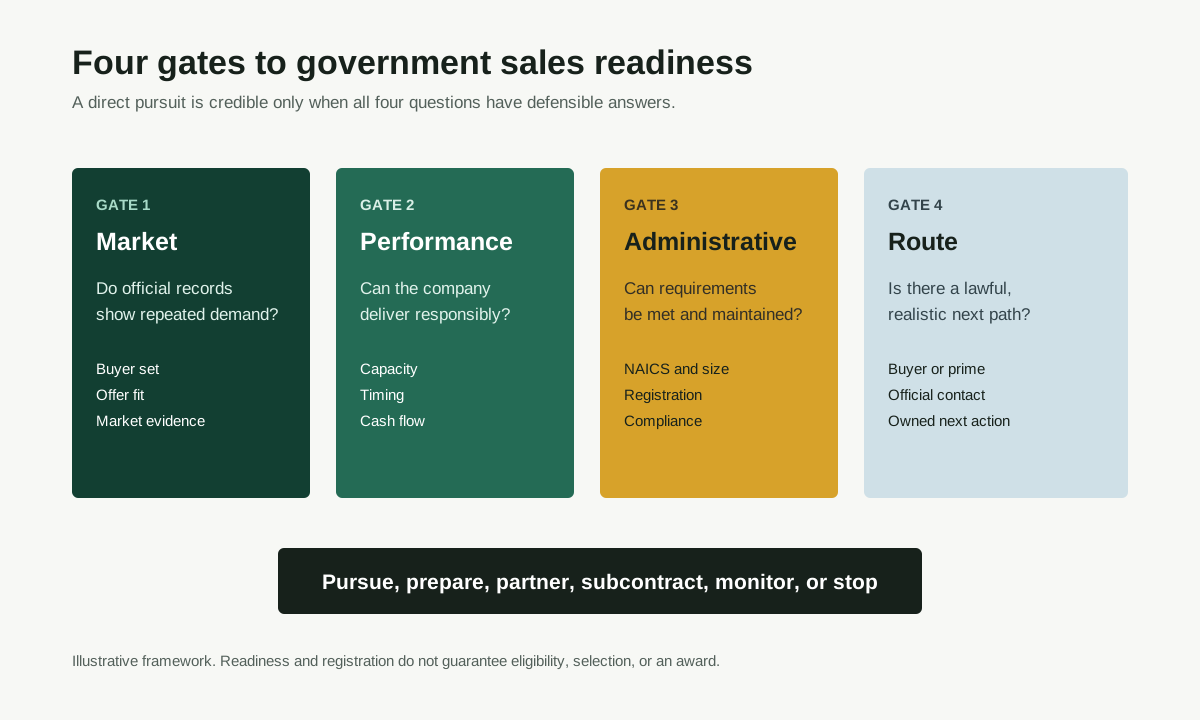
Four gates to government sales readiness
Direct pursuit becomes credible only when market, performance, administrative, and route gates all have defensible answers.
Open visual full sizeIllustrative decision framework. Passing a gate does not guarantee eligibility, selection, or an award. Source: Illustrative Opportunity Scanner readiness framework informed by SBA and SAM.gov guidance
Sources cited
Put this into the product
Run a free company scan to test market evidence first, then decide whether your next move is direct pursuit, preparation, partnering, subcontracting, or monitoring.
Opportunity Scanner classifies the evidence, opens the official route, and lets you start a pursuit with an owner, fit decision, next step, internal due date, and notes.
Scan Your Company WebsiteKeep exploring
Related reads
Government Contracts
SAM.gov Is Not Enough: How to Spot Earlier Public-Sector Signals
Use SAM.gov with spending history, grants, recipients, forecasts, policy, and state or local sources to build a more complete opportunity pipeline.
7 min read
Public-Sector Sales
Why Government Spending Is an Overlooked Growth Channel for Businesses
A practical guide to using contracts, awards, grants, recipients, and forecasts as evidence for new public-sector revenue paths.
7 min read
Opportunity Intelligence
What Is a Public-Sector Opportunity Signal?
Learn how to classify public-sector opportunity signals, reject weak matches, and turn credible evidence into a target and next action.
7 min read