
Marketing and Advertising Public-Sector Opportunities: A Source-Backed Market Map
A source-backed market map for agencies offering public outreach, advertising, media buying, content, video, web, digital experience, and related specialist services.
Quick answer
The short answer
Marketing and advertising firms can find real public-sector demand, but the market is broader and more structured than a search for 'government marketing contracts.' An active media-placement solicitation, an expired sources-sought notice, a historical award, a grant-funded city's engagement plan, a GSA service category, and a federal digital-experience policy can all be useful. They do not prove the same thing. The work begins by classifying the source, matching only substantiated capabilities, and choosing the revenue motion the record actually supports.
Key takeaways
- Keep active procurement, historical awards, funded recipients, and market intelligence in separate pipeline lanes.
- Translate a commercial agency portfolio into public buying language such as advertising, public relations, media buying, research, video production, web-based marketing, accessibility, and stakeholder engagement.
- A marketing firm may sell directly to an agency, support a funded recipient, subcontract to a prime, or monitor future demand; not every firm fits every route.
- Preserve the official status, dates, source-native contact, eligibility, scope, and one next action before a row enters sales workflow.
Start with four evidence lanes, not one lead list
Active procurement is the narrowest and most time-sensitive lane. A current solicitation, request for quotation, or combined synopsis can support a Sell to Agency decision when the response window remains open and the firm can meet the scope, set-aside, geography, vehicle, and submission requirements. The notice and its latest attachments control. A search result, cached deadline, or original version is not enough.
Historical awards are a different lane. USAspending explains that award spending covers money the federal government paid or promised to a non-federal recipient through contracts or financial assistance. Those records can reveal buying agencies, award recipients, periods of performance, NAICS or product/service codes, and subaward patterns. They prove that money moved; they do not prove that budget is available now or that a prime has an open subcontract.
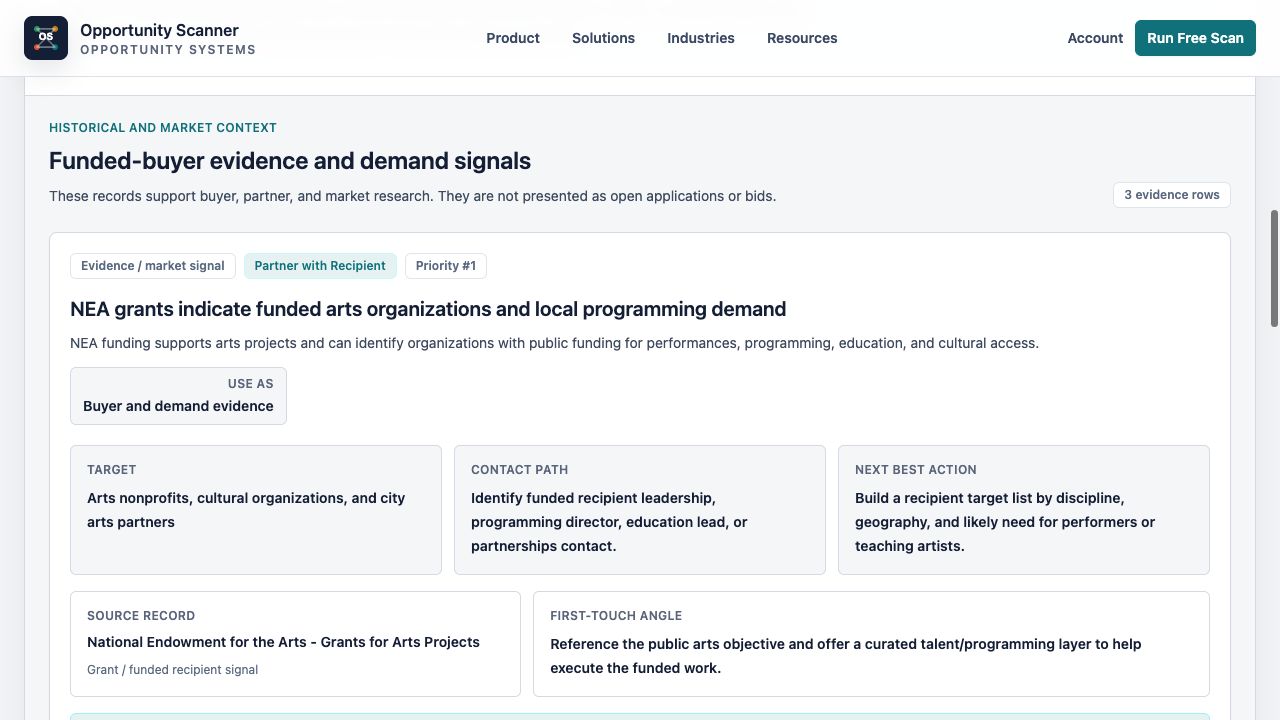
Funded recipients and market intelligence complete the map. A city with a grant-funded engagement activity may become a buyer only after its project and procurement route are verified. A GSA service description, agency operational plan, forecast, sources-sought notice, or digital policy can help a firm understand recognized demand and prepare, but it belongs in Research Only until a current buyer action appears.
Translate the portfolio into public buying language
Public buyers rarely organize work around an agency's preferred phrase such as full-service growth marketing. GSA's Multiple Award Schedule separates advertising, public relations, marketing research, video and film production, graphic design, web-based marketing, and event-related services. A company website should be mapped to the specific activities it can prove: strategy, research, creative, paid media, production, outreach, translation, content operations, web delivery, analytics, or accessibility support.
That translation is useful even when a firm does not hold a Schedule contract. It improves search terms, capability statements, prime-partner research, and bid/no-bid decisions. It also exposes gaps. A creative studio may be strong at campaign assets but unable to manage media placement. A web firm may deliver accessible front ends but lack federal security experience. A media buyer may not provide community engagement or multilingual content.
Use exclusions as aggressively as capabilities. Record geographic limits, minimum and maximum project size, regulated-industry experience, security boundaries, production capacity, media relationships, accessibility evidence, language coverage, subcontractor dependencies, and contract-vehicle status. A smaller qualified lane is more useful than a broad list the team cannot pursue.
Qualify active procurement from the latest notice
SAM.gov is the federal source for contract opportunities, but notice types represent different stages. A solicitation or combined synopsis may request offers. A presolicitation notice may preview a requirement. A sources-sought notice or request for information usually supports market research and may ask for capability input without committing the government to an acquisition. A special notice may communicate an intent, industry event, or sole-source rationale rather than invite a competitive bid.
The July 8, 2026 Event Center Advertising notice illustrates a bid-oriented record: SAM.gov marked it active at the July 13 review, identified a small-business set-aside, included attachments, and listed a July 17 response deadline. That evidence supports rapid qualification, not automatic pursuit. The team still has to inspect the amended RFQ, statement of objectives, placement requirements, performance location, evaluation terms, and authorized response route.
The action row should preserve notice ID, notice type, active status, published and response dates, set-aside, NAICS and product/service code, place of performance, scope summary, attachments reviewed, source-native contact, and a bid/no-bid owner. If the deadline has passed, the notice becomes historical or market intelligence even when a page remains visible.
Turn awards and funded recipients into research, not invented intent
Award history can answer useful questions: which agencies have bought adjacent services, which firms received the work, whether an award remains in its period of performance, and which codes or descriptions recur. Search multiple terms because communications work may be classified under advertising, public relations, media buying, research, video, graphic design, web, consulting, event support, or a broader program-management award.
For each historical contract, verify the awarding office, recipient, award description, dates, obligations, and any official subaward or task-order context. Then choose Research Only or Sell to Award Recipient based on current evidence. The credible subcontracting action is to inspect the prime's supplier or small-business route and identify a specific delivery gap. It is not to tell the recipient that its award proves it needs your agency.
Financial-assistance recipients require another check. DOT's SS4A materials, for example, identify stakeholder engagement, collaboration, public meetings, surveys, progress reporting, and public final products as relevant planning activities, and state that eligible applicants may use consultants under procurement standards. A named recipient can support funded-buyer research, but only its project documents and local purchasing activity can establish whether external communications work exists.
Choose direct, recipient, and subcontracting motions deliberately
Sell to Agency fits a current direct buying route. Sell to Funded Buyer fits a verified public entity or organization with relevant funding and a plausible vendor need. Sell to Award Recipient fits a contractor or other recipient already responsible for adjacent delivery. Partner with Recipient fits a complementary implementation relationship where the recipient controls the funded objective. Research Only fits category, policy, forecast, planning, and historical evidence that lacks a current buying action.
SBA's prime and subcontracting guidance provides practical routes: its directory of federal prime contractors with subcontracting plans, agency subcontracting resources, and SUBNet can help small businesses research larger contractors. Use these alongside current award and procurement evidence. A prime directory alone does not establish that the prime needs a communications subcontractor, and a generic teaming email rarely demonstrates fit.
The outreach angle should connect one proven capability to one sourced public objective. Examples include multilingual participation for a named planning effort, accessible video and captioning for public education, regional media buying for recruitment, or content design for a digital service. Avoid implying endorsement, guaranteed budget, incumbent relationships, certification, or past performance the firm does not have.
Build a marketing opportunity action table
Every retained row should contain source URL, retrieval date, evidence class, current status, target organization, buying or program office, scope, geography, codes, set-aside or eligibility, revenue motion, contact path, next action, owner, due date, and disqualifier. Add incumbent or recipient fields only when an official source identifies them. Keep source-native procurement contacts ahead of enrichment.
Use a short disqualifier list: response period closed; no matching capability; mandatory vehicle unavailable; set-aside mismatch; place of performance unsupported; project too large or too small; inaccessible deliverables cannot be produced; media, language, or security requirements cannot be met; or no current route to a buyer or prime. A rejected row can remain as market history without inflating active pipeline.
Opportunity Scanner's role is to keep the evidence attached while translating it into action. The output is not a promise that public-sector marketing work is easy or universal. It is a disciplined map showing which records deserve a bid review, recipient check, prime conversation, future monitor, or no action.
Marketing-services opportunity qualification checklist
- 1Classify the record as active procurement, historical award, funded recipient, or market intelligence.
- 2Recheck status, latest amendment, response date, and attachments at the official source.
- 3Map only substantiated capabilities to the requested advertising, outreach, content, video, web, research, or media scope.
- 4Confirm set-aside, geography, vehicle, registration, performance, security, accessibility, and submission requirements.
- 5For awards, preserve period of performance and obligations without treating them as current budget.
- 6For funded recipients, verify the funded purpose and a current local procurement or partner route.
- 7For primes, use official supplier, subcontracting, or small-business routes and name one credible capability gap.
- 8Choose one allowed revenue motion and one source-native contact path.
- 9Assign an owner, deadline, next action, and disqualifier before moving the row into CRM.
- 10Remove closed, unsupported, duplicated, or capability-mismatched records from active pipeline.
Sources cited
Put this into the product
Run a free scan to map your agency's proven capabilities to qualified procurement, recipient, prime, and market-intelligence rows.
Opportunity Scanner classifies the evidence, opens the official route, and lets you start a pursuit with an owner, fit decision, next step, internal due date, and notes.
Scan Your Company WebsiteKeep exploring
Related reads
Industry Guides
Infrastructure Opportunities for Construction Companies
A source-backed workflow for finding infrastructure projects, public owners, funded recipients, primes, subcontracting routes, and supplier demand.
7 min read
Industry Guides
Clean Energy Public-Sector Opportunities
How clean-energy and facilities companies can distinguish grants, rebates, procurement, policy, funded buyers, and implementation routes.
7 min read
Industry Guides
Manufacturing and Supply Chain Public-Sector Demand
A practical source-to-action guide for manufacturers, suppliers, logistics providers, and industrial service companies pursuing public-sector demand.
7 min read