
Healthcare Public-Sector Opportunities: VA, Medicaid, Rehab, DME, and Community Health Signals
A source-backed guide for healthcare, rehab, DME, medical supply, and patient-support companies evaluating agency, provider, channel, and reimbursement opportunities.
Quick answer
The short answer
Healthcare public-sector opportunity is not one market and it is not one buying process. A VA supply contract, a Medicare supplier dataset, a HRSA-funded health center, a Medicaid policy change, and a community-health grant can all be commercially relevant, but each creates a different target, revenue motion, contact path, and next action. Healthcare companies need a qualification system that preserves those differences before a sales team starts outreach.
Key takeaways
- Separate procurement, funded-provider, channel, reimbursement, and policy signals before assigning a sales action.
- Use CMS and HRSA data to understand provider markets, but do not describe enrollment, utilization, or an award as an open purchase.
- VA medical purchasing often runs through schedules, national contracts, and prime-vendor structures, so a channel route may be more realistic than a facility-level pitch.
- A useful healthcare row connects the official source to a verified target, a permitted revenue motion, the right contact path, and one owned next action.
From real scans — public records surfaced by Opportunity Scanner
Funded-buyer evidence from a real healthcare / dme / medical supply scan
Historical public award records surfaced for a compression-garment and recovery products brand. As of .
$95,922,714
Historical award - 2018
- Recipient
- Peraton Enterprise Solutions
- Agency
- HHS
- Source system
- USAspending award record
DME, Medicare, and reimbursement infrastructure. Reimbursement infrastructure can create an enterprise partner route around DME purchasing.
$17,139,378
Historical award - 2021
- Recipient
- Valiant Construction LLC
- Agency
- Dept. of Veterans Affairs
- Source system
- USAspending award record
award adjacent to prosthetics and orthotics purchasing. A VA prosthetics-clinic design-build award proves facility investment around the care pathway; it does not prove an open medical-supply purchase.
$133,587
Historical award - 2019
- Recipient
- BSN Medical Inc.
- Agency
- NASA
- Source system
- USAspending award record
funded-buyer signal. Direct medical-supply demand can appear in agencies a seller would not normally target.
Healthcare demand appears in five different lanes
The first lane is direct procurement. SAM.gov notices, VA acquisition pages, state purchasing systems, and local health-department solicitations can identify an agency that is actively researching or buying products and services. Notice type, deadline, place of performance, required vehicle, and response instructions determine whether the row is a current Sell to Agency opportunity, an early Sources Sought response, or only a monitoring task.
The second lane is funded providers. HRSA publishes active and awarded grant data and detailed Health Center Program data. Those records can reveal community health centers, service sites, and program areas that already receive public support. They are evidence for account research, not proof that a recipient is currently shopping. A commercial company should use Sell to Funded Buyer or Partner with Recipient only after verifying the recipient, award purpose, timing, and a plausible need connected to its offer.
The remaining lanes are channel structures, reimbursement and provider-market evidence, and policy. A medical supplier may need a distributor or schedule route; a rehab company may use CMS data to map participating suppliers or service patterns; and a reimbursement proposal may justify Monitor Policy rather than immediate outreach. Keeping these lanes separate prevents a report from turning every healthcare record into the same generic lead.
Start with the product category and the care setting
Healthcare websites often describe outcomes in commercial language: faster recovery, patient comfort, mobility, adherence, staff efficiency, or better home care. Public records may describe the same offer through care settings, benefit categories, supply classifications, clinical services, or operational requirements. A DME-adjacent product may appear under mobility equipment, prosthetics, orthotics, rehabilitation, home health, durable supplies, patient support, or a specific Federal Supply Classification rather than the company's preferred category name.
Translate the offer into three layers before searching. First, define the product or service precisely. Second, list the settings where it can be delivered, such as VA medical centers, community health centers, state facilities, home health, rehabilitation providers, or Medicaid delivery systems. Third, identify the public objective it supports, such as access, continuity of care, inventory reliability, workforce capacity, or patient mobility. This translation creates better search terms and gives the team a reason to reject adjacent records that do not match actual performance.
Do not infer regulatory status, coverage, coding, clinical effectiveness, or procurement eligibility from a website description. Those are separate diligence questions. Opportunity intelligence can identify where evidence of demand exists, but the company still has to verify product classification, licensing, enrollment, reimbursement, security, and performance requirements that apply to the specific route.
Read CMS and HRSA data as market evidence
CMS's Provider Data Catalog explains that its medical-equipment supplier data is collected weekly through PECOS and includes the equipment categories associated with enrolled suppliers. That makes it useful for market mapping: a team can identify supplier density, category coverage, and organizations that participate in Medicare. Participation does not mean a supplier has budget, wants a partner, or is an approved target for unsolicited outreach. The row should preserve the dataset date and state what it actually proves.
CMS also publishes DME, device, and supply utilization and payment datasets. These can help a team understand where Medicare-covered products and services have historically been furnished, but payment records are not forecasts. They should support Research Only, market sizing, territory prioritization, or a hypothesis that must be checked against current policy and buyer evidence. Never convert a utilization figure directly into an addressable sales forecast without explaining coverage, data-year, suppression, and methodology limits.
HRSA's Health Center Program data offers a different view. HRSA reported that its funded health centers served 32.4 million patients in 2024 and provides awardee, service-site, grant, staffing, cost, revenue, and service data. A company can use those records to identify verified organizations and program context. The next action is usually to examine the award purpose and organization, then determine whether the appropriate route is procurement, operations, partnerships, a program office, or monitoring.
Treat VA healthcare as a system of vehicles and channels
The VA National Acquisition Center says it manages high-volume schedules, national contracts, blanket purchase agreements, and direct-delivery programs for pharmaceuticals, medical and surgical supplies, patient-mobility equipment, high-technology equipment, staffing, and related services. This is strong evidence that the VA buys across these categories. It is not evidence that every facility can purchase outside the applicable vehicle or that every vendor should begin with a local medical-center contact.
VA's Medical/Surgical Prime Vendor program illustrates why channel logic matters. The program centralizes supply-chain management and uses prime vendors and strategically sourced agreements. For some manufacturers and suppliers, the credible motion may be Channel / Distributor Motion, work with a prime, or research a schedule path. For another company, an active SAM.gov notice with a source-native contracting contact may justify Sell to Agency. The source determines the route.
Preserve the hierarchy in the action table: the buying office or program, relevant contract vehicle, incumbent or prime when officially identified, product classification, notice or contract status, and the authorized contact route. A generic 'contact the VA' instruction is not actionable and may ignore the actual purchasing structure.
Use grants and policy without inventing a buyer
Grants.gov requires applicants to check the legal eligibility in each opportunity's instructions. A healthcare grant limited to public entities, nonprofits, universities, tribes, or healthcare organizations is not a Direct Apply opportunity for an ineligible commercial supplier. It can become a future funded-buyer lane only after an official award identifies a recipient and the funded work creates a credible vendor or partner need.
Medicaid and reimbursement records need similar restraint. State plan amendments, waivers, fee schedules, coverage guidance, and proposed rules may change how services are funded or delivered. Until an effective policy, implementation plan, procurement, or funded organization creates an operational route, the correct motion may be Monitor Policy. Assign an owner to track the responsible agency, effective dates, implementation documents, and downstream buyer evidence rather than creating a premature sales lead.
This distinction protects credibility. A policy signal can be strategically important even when it has no immediate contact. A grant can reveal a future ecosystem without giving the company permission to claim eligibility. A historical award can validate demand without proving current budget. The report should explain which statement is supported and what evidence would be needed to advance the row.
Build an industry-specific Opportunity Action Table
Every retained healthcare row should include the source and retrieval date, target organization, care setting, product or service category, evidence summary, status, revenue motion, eligibility or vehicle check, contact path, next action, owner, due date, and disqualifier. Add reimbursement or policy fields only when they materially affect the route. Keep source-native contacts and official vendor instructions ahead of paid contact enrichment.
A real Opportunity Scanner scan for a compression-garment and recovery products brand surfaced 14 sourced signals across five federal agencies and two source systems. The historical records showed three tiers of funded-buyer evidence: Peraton Enterprise Solutions received a $95,922,714 HHS award in 2018 for DME, Medicare, and reimbursement infrastructure; Valiant Construction LLC received a $17,139,378 Department of Veterans Affairs award in 2021 adjacent to prosthetics and orthotics purchasing; and BSN Medical Inc. received a $133,587 NASA award in 2019. These awards proved that budgets existed around reimbursement infrastructure, VA care pathways, and direct agency medical-supply buying. They did not establish a current purchase, open opportunity, or response date.
Opportunity Scanner's role is to perform this translation consistently: source to target, target to motion, motion to contact path, and contact path to next action. The result should help a healthcare operator decide where to invest diligence, where a channel partner is required, and where the honest answer is to monitor or reject the record.
Healthcare opportunity qualification checklist
- 1Name the exact product or service, care setting, and public objective being tested.
- 2Classify the record as procurement, funded provider, channel, provider-market evidence, reimbursement, or policy.
- 3Confirm the source date, record status, target organization, geography, and program or buying office.
- 4Check whether Direct Apply is legally available before treating a grant as an application path.
- 5For VA demand, identify any schedule, national contract, prime-vendor, or ordering structure that controls the route.
- 6For CMS data, preserve the data year and methodology and avoid treating historical utilization as current demand.
- 7For HRSA recipients, verify the award purpose and a plausible vendor or partner need before outreach.
- 8Use source-native contacts, procurement offices, and official vendor instructions before personal-email enrichment.
- 9Assign one revenue motion, one owner, one next action, and one disqualifier to every retained row.
- 10Reject records that fail product fit, regulatory feasibility, eligibility, geography, timing, vehicle access, or a credible route.
Charts and visual evidence
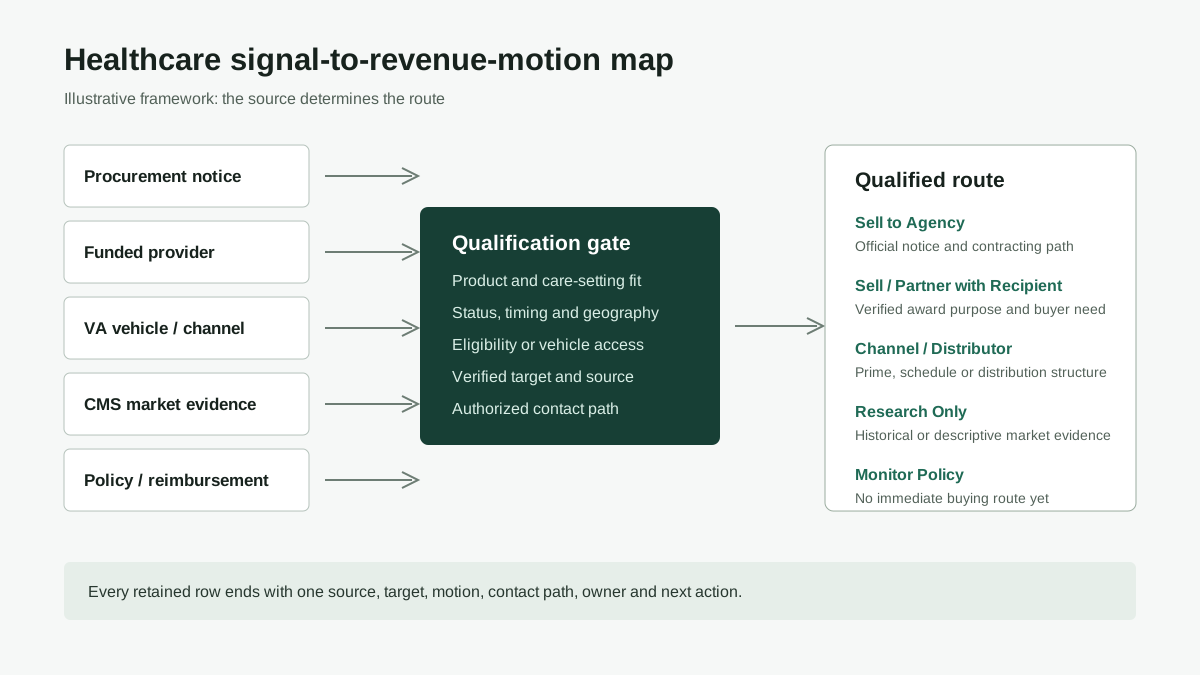
Healthcare signal-to-revenue-motion map
Healthcare sources require different commercial routes; the source record should determine the motion and contact path.
Open visual full sizeIllustrative routing framework; it does not show measured conversion or purchasing results. Source: Illustrative Opportunity Scanner framework informed by CMS, HRSA, VA, SAM.gov, and Grants.gov source structures
Sources cited
Put this into the product
Run a free scan to turn your healthcare offer and official public records into qualified agency, provider, channel, and policy action rows.
Opportunity Scanner classifies the evidence, opens the official route, and lets you start a pursuit with an owner, fit decision, next step, internal due date, and notes.
Scan Your Company WebsiteKeep exploring
Related reads
Industry Guides
Infrastructure Opportunities for Construction Companies
A source-backed workflow for finding infrastructure projects, public owners, funded recipients, primes, subcontracting routes, and supplier demand.
7 min read
Industry Guides
Clean Energy Public-Sector Opportunities
How clean-energy and facilities companies can distinguish grants, rebates, procurement, policy, funded buyers, and implementation routes.
7 min read
Industry Guides
Manufacturing and Supply Chain Public-Sector Demand
A practical source-to-action guide for manufacturers, suppliers, logistics providers, and industrial service companies pursuing public-sector demand.
7 min read