
How to Build a Public-Sector Sales Pipeline Without a GovCon Team
A practical 30-day market test for companies that want to validate public-sector demand before hiring a capture team.
Quick answer
The short answer
You do not need a full government contracting department to test whether public-sector demand exists. Start with a small, evidence-backed pipeline: a few qualified source records, the right revenue motion for each one, a credible contact route, and a next action your existing team can own.
Key takeaways
- Treat the first month as a channel test, not a commitment to build a GovCon department.
- Keep active solicitations, historical spending, grants, funded recipients, and forecasts in separate pipeline lanes.
- Do not register, enrich contacts, or chase every keyword match before fit, eligibility, timing, and route are clear.
- The useful output is an Opportunity Action Table with evidence, target, motion, owner, and next action.
Test the channel before you build the department
The first public-sector decision is not which registration to complete or which bid portal to buy. It is whether agencies, prime contractors, funded organizations, schools, health systems, workforce programs, or other public-sector participants show repeat demand for something your company already delivers well.
That distinction matters because a commercial company can spend weeks learning acronyms and completing profiles without proving there is a realistic market. The U.S. Small Business Administration recommends starting with market research: determine whether government buyers purchase what you sell, how much demand exists, and which organizations buy it. Historical spending and agency procurement forecasts can help answer those questions before a team commits to a pursuit.
Define the test narrowly. Choose two or three existing offers, one or two buyer problems, and a small set of industries or geographies. The goal is not to collect every government-adjacent record. The goal is to find enough credible evidence to decide whether to pursue directly, sell to an agency, sell to a funded buyer, partner with a recipient, subcontract through a prime, monitor future demand, or stop.
Gate 1: Check readiness before pursuing a solicitation
A relevant keyword is not the same as a pursuable opportunity. Before assigning a seller, check whether the company can describe the offer in the buyer's terminology, deliver at the likely scale and location, support the required timeline, and meet the compliance or performance conditions visible in the source record. A company should also identify the NAICS codes that genuinely describe its work; SBA size standards vary by NAICS code, so there is no single threshold that makes every company a small business for every opportunity.
SAM.gov registration becomes necessary when a company plans to bid or apply directly as a prime awardee. Registration is free, produces the Unique Entity ID, must be renewed, and can take time to activate. That makes registration an operational dependency to plan for, not the first proof that a market exists. A business that is only researching, targeting funded recipients, or exploring subcontracting may be able to validate the lane before treating full registration as the immediate next step.
Use outside help when the requirements exceed the team's experience. SBA points businesses to APEX Accelerators for readiness assessment, registration, certification questions, and research into past opportunities. The right early adviser can prevent a team from mistaking a registration task for a sales strategy or pursuing a notice it cannot responsibly perform.
Gate 2: Build evidence from four official source lanes
SAM.gov is the active federal procurement lane. Anyone can search contract opportunities without an account, although an account supports saved searches and followed opportunities. Notice type matters: a solicitation or combined synopsis/solicitation is different from a presolicitation, special notice, award notice, justification, or Sources Sought notice. FAR 15.201 explains that an RFI may be used for planning when the government does not presently intend to award a contract and that responses are not offers. A Sources Sought response can be a useful early-market action, but it should not be represented as a bid or guaranteed future solicitation.
USAspending.gov is the historical money-flow lane. It shows contracts, grants, loans, and other federal financial assistance, including agencies, recipients, award amounts, award types, and places of performance. This can reveal prior buyers, incumbent vendors, funded nonprofits, universities, health providers, workforce organizations, distributors, and primes. It is market evidence, not an open opportunity. An old award can justify buyer research or forecast monitoring, but it does not prove that budget is currently available.
Grants.gov is the federal funding lane. Search filters distinguish forecasted, posted, closed, and archived opportunities, and the official notice controls eligibility. A posted grant restricted to state agencies, school districts, workforce boards, universities, or nonprofits is not a Direct Apply opportunity for an ineligible commercial company. It may instead point to a future funded buyer or partner lane, but the team should wait for credible recipient evidence before describing any organization as funded.
Agency procurement forecasts are the planning lane. Acquisition.gov maintains links to agency forecasts, business-opportunity pages, small-business offices, and vendor communication plans. Forecasts can reveal anticipated demand before a solicitation is posted, but they remain planning signals. Keep the expected quarter, office, category, and procurement method visible, and route the row to research or monitoring until an official active notice creates a different action.
Gate 3: Turn source records into qualified action rows
A public-sector pipeline should not be a bookmark folder. Each retained record needs an official source URL, source and retrieval dates, target organization, evidence summary, status, revenue motion, fit assessment, eligibility assessment, contact route, next action, owner, due date when one exists, and a clear disqualifier. That structure allows an existing sales or partnerships team to work the pipeline without learning every portal first.
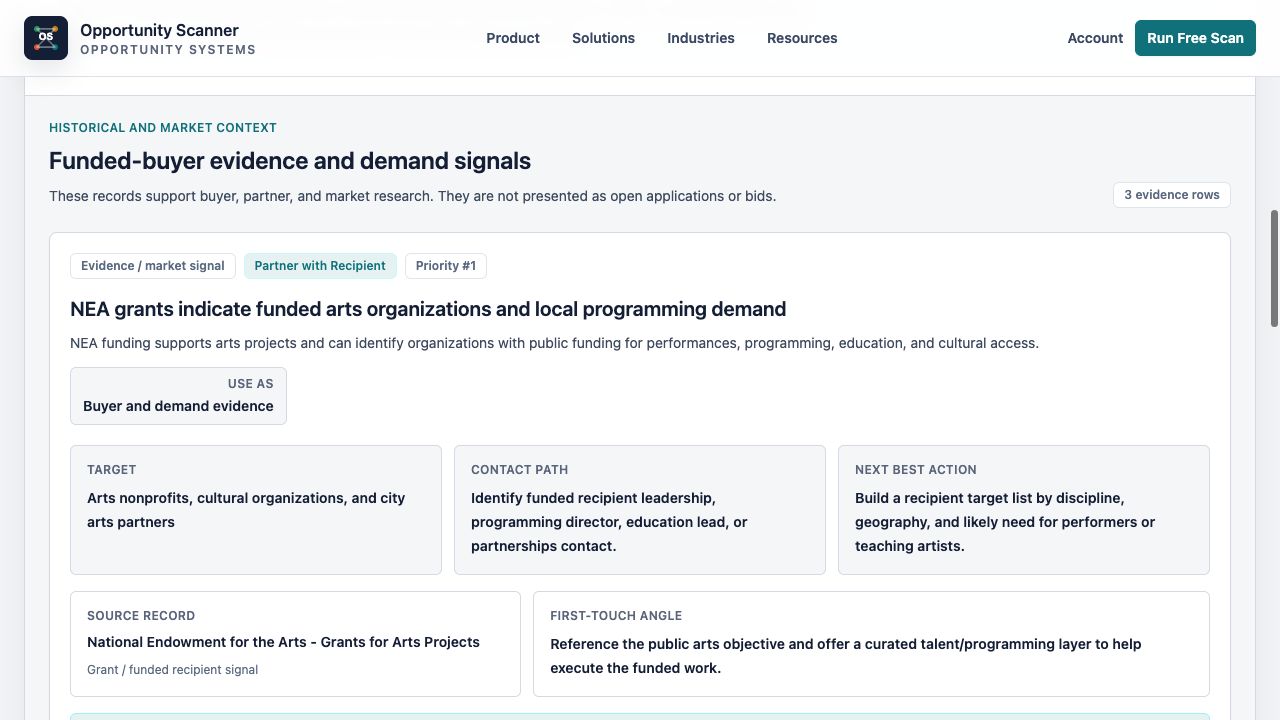
Use a small set of revenue motions consistently. Direct Apply means the company is plausibly eligible to submit. Sell to Agency means the agency or public entity is the likely buyer. Sell to Funded Buyer or Sell to Award Recipient means a named recipient may need vendors or implementation support. Partner with Recipient covers a credible complementary role. Channel or Distributor Motion is appropriate when a funded prime, distributor, or implementation partner is the practical route. Monitor Policy and Research Only keep early or incomplete evidence visible without inflating the active pipeline.
Qualification should remove more rows than it promotes. Reject weak keyword matches, expired records with no continuing market value, grants where the company is ineligible and no recipient path exists, requirements materially outside the offer, unrealistic deadlines, and records with no credible buyer, partner, registration, response, or monitoring route. A truthful zero-match result is more useful than a long table of false positives.
Choose the contact route that matches the signal
The correct next person is not always a named buyer with an enriched email. For an active SAM.gov notice, start with the source-native point of contact and the response instructions. After a solicitation is released, FAR 15.201 identifies the contracting officer as the focal point for exchanges with potential offerors. Do not use informal outreach to work around the official process or seek nonpublic source-selection information.
Earlier in the market cycle, an agency small-business office, program office, forecast owner, vendor-registration page, industry day, or APEX adviser may be the better route. SBA recommends researching forecasts and historical awards before approaching an Office of Small and Disadvantaged Business Utilization or Office of Small Business Programs. That preparation lets the team ask a specific capability and timing question instead of sending a generic introduction.
For a funded commercial or nonprofit recipient, the route may be a program leader, partnerships owner, procurement contact, operations leader, or prime-contractor relationship. Verify the organization and its role before using paid enrichment. Public agencies should generally remain routed to official offices, portals, and source contacts rather than indiscriminate personal-email discovery.
Run a 30-day public-sector pipeline test
In week one, translate the company's offers into buyer problems, mission language, likely NAICS codes, product or service terms, and obvious exclusions. Decide what would count as a strong signal before searching: a current notice with fit and time to respond, repeated historical spending by a relevant agency, a forecast tied to the offer, or a funded organization with a credible vendor or partner need.
In week two, collect a deliberately small evidence set across SAM.gov, USAspending, Grants.gov, and selected agency forecasts. Preserve official links and source dates. Do not merge the lanes into one generic opportunity list. Five well-explained records are enough to test classification, while fifty weak matches usually hide the decisions the team needs to make.
In week three, qualify each row and assign one owner and one next action. That action might be reviewing attachments, responding to a Sources Sought notice, confirming eligibility, checking an agency forecast, mapping an incumbent prime, researching a recipient, registering in a vendor portal, requesting APEX guidance, or scheduling a future monitoring date. Use a CSV, webhook, task list, or existing CRM before investing in a complex native integration.
In week four, review what the evidence says. Continue when relevant demand repeats, the company can perform, and at least one practical route survives qualification. Narrow the segment when only one buyer type or motion appears credible. Partner or subcontract when direct prime pursuit is unrealistic. Pause when timing or readiness is the main blocker. Stop when the evidence repeatedly fails fit, eligibility, capacity, or route.
Three examples of evidence becoming action
A software company may find repeated USAspending awards for a relevant service. The initial row should be Research Only or Sell to Agency, with the agency, incumbent, award history, office, and a next step to check forecasts or active notices. Historical spending alone does not mean a new purchase is available, and no meeting or revenue outcome should be assumed.
A training company may find a posted workforce grant limited to workforce boards or nonprofits. If the company is not eligible, the row should not say Direct Apply. It can become Partner with Recipient research, with a task to monitor official awards and assess a complementary delivery role only after a recipient is credibly identified.
An equipment or services company may find a matching SAM.gov Sources Sought notice. The row should preserve the notice type, agency, response instructions, NAICS code, deadline, and contracting contact. The next action may be a capability response, but the record should not be called a contract or solicitation, and responding does not imply an award will follow.
Know when to invest further and when to stop
A successful test does not require an immediate contract. It requires enough credible evidence to make the next investment rational: complete registration, focus on a specific agency or funded-buyer segment, build a partner route, prepare for a forecasted procurement, or establish a repeatable monitoring and qualification cadence.
Do not scale the effort because the source list is long. Scale when the same buyer problems appear across official records, the team can meet the likely requirements, and the action table produces work that owners actually complete. Opportunity Scanner can accelerate the source-to-action translation, but it does not guarantee eligibility, access, solicitations, responses, meetings, or awards.
30-day pipeline test checklist
- 1Choose two or three existing commercial offers to test.
- 2Translate each offer into buyer problems, mission terms, likely NAICS codes, and search phrases.
- 3Verify small-business status separately for each relevant NAICS code.
- 4Search SAM.gov without treating every notice type as a solicitation.
- 5Record notice status, response date, office, set-aside, NAICS code, attachments, and official contact.
- 6Use USAspending to test historical agency and recipient demand while keeping awards separate from active opportunities.
- 7Check Grants.gov eligibility before assigning a Direct Apply motion.
- 8Treat ineligible grant records as recipient or partner research only when a credible downstream route exists.
- 9Review agency forecasts and small-business-office routes for earlier demand.
- 10Assign one revenue motion, one owner, and one next action to every retained row.
- 11Preserve the official source URL and retrieval date.
- 12Reject weak fit, failed eligibility, expired timing, unrealistic performance, and records with no credible route.
- 13Plan SAM.gov registration when direct federal bidding or application becomes an actual motion.
- 14Use APEX or an appropriate adviser when requirements exceed the team's expertise.
- 15Move qualified rows through a simple CSV, webhook, task list, or existing CRM before buying a complex stack.
- 16After 30 days, decide whether to invest, narrow, partner, subcontract, monitor, pause, or stop.
Charts and visual evidence
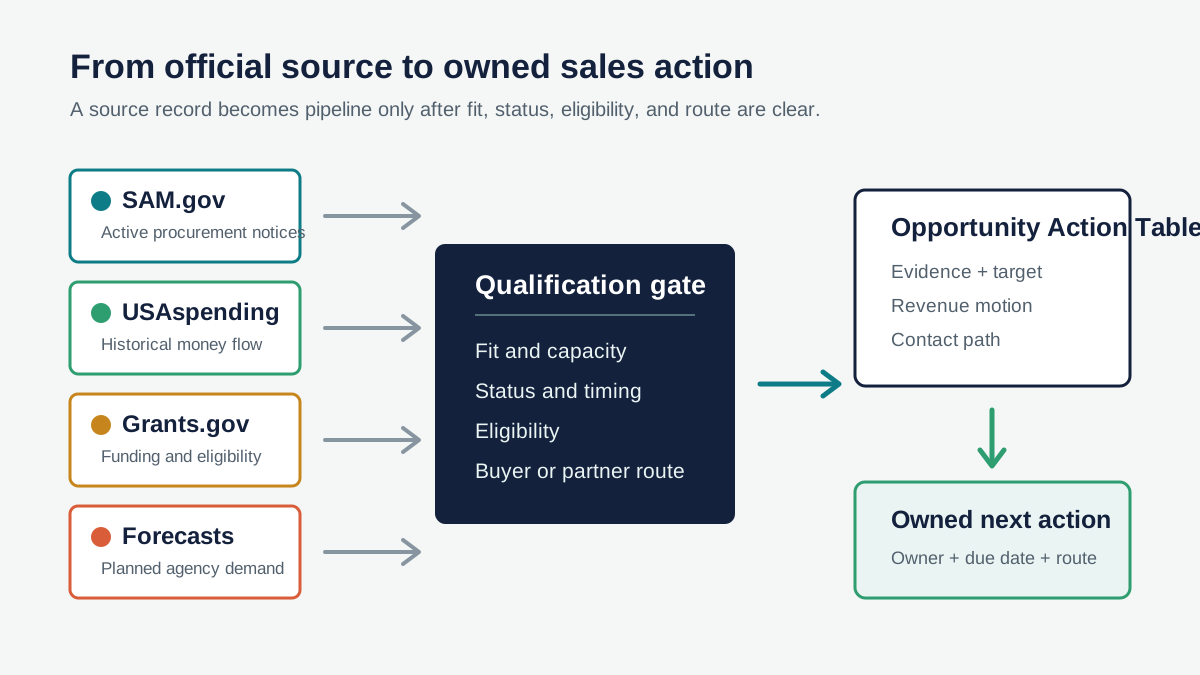
From official source to owned sales action
Different source records create different revenue motions. Qualification and routing must happen before a record becomes pipeline.
Open visual full sizeIllustrative workflow; it does not represent measured conversion results. Source: Opportunity Scanner framework using official SAM.gov, USAspending.gov, Grants.gov, and acquisition forecast lanes
Sources cited
Put this into the product
Run a free scan to turn your company website and official public-sector records into a small, evidence-backed Opportunity Action Table.
Opportunity Scanner classifies the evidence, opens the official route, and lets you start a pursuit with an owner, fit decision, next step, internal due date, and notes.
Scan Your Company WebsiteKeep exploring
Related reads
Public-Sector Sales
Why Government Spending Is an Overlooked Growth Channel for Businesses
A practical guide to using contracts, awards, grants, recipients, and forecasts as evidence for new public-sector revenue paths.
7 min read
Public-Sector Sales
Public-Sector Deal Flow for Commercial Companies
A practical system for turning official public-sector records into qualified commercial deal flow, owned actions, and honest stop decisions.
8 min read
Public-Sector Sales
How to Use Sample Opportunity Reports to Plan Public-Sector Outreach
Use industry sample reports to evaluate public-sector fit, understand opportunity evidence, and plan more relevant outreach.
6 min read