
Public-Sector Deal Flow for Commercial Companies
A practical system for turning official public-sector records into qualified commercial deal flow, owned actions, and honest stop decisions.
Quick answer
The short answer
Commercial companies rarely need a second generic lead list. They need evidence that a public agency, funded organization, prime contractor, or program operator has a relevant need and a credible route to buy. Public-sector deal flow starts when official records are separated by meaning, qualified against the company's offer, and assigned to an owner. This guide shows how to build that system without pretending every award is open budget or every notice is a bid.
Key takeaways
- Keep active opportunities, historical spending, funded recipients, forecasts, and policy signals in separate lanes.
- Every retained signal needs a target, revenue motion, contact path, owner, next action, and disqualifier.
- A smaller pipeline of source-backed rows is more useful than a large list of weak keyword matches.
Deal flow begins with market evidence, not portal volume
A commercial sales team usually knows its offer, buyer problems, delivery limits, and strongest proof. What it often lacks is a reliable view of public demand. SBA recommends researching whether government buyers purchase what the company sells, how large the market is, and which agencies buy it. That is the right starting point because it tests a commercial hypothesis before the team invests in registrations, capture processes, or specialist software.
Define two or three offers and the public problems they solve. Translate each into agency mission language, likely NAICS or product/service categories, recipient types, geographies, and clear exclusions. A rehabilitation supplier, for example, should distinguish medical equipment from clinical services and facility construction. A training platform should separate direct agency procurement from grant-funded delivery through workforce boards or schools.
The output is not a search result. It is a decision row. Preserve the official source, identify what the record proves, name the likely target, select one revenue motion, and state what must happen next. If the evidence cannot support that sequence, it belongs in research or rejection rather than active pipeline.
Build five lanes that do not blur together
The active procurement lane contains current notices and source instructions. SAM.gov may show solicitations, presolicitations, Sources Sought notices, awards, and special notices. Those record types do not create the same action. A current solicitation may justify a bid/no-bid review; a Sources Sought notice may justify a capability response; an award notice may identify an incumbent or future subcontracting route.
The historical money-flow lane comes from USAspending and related official award systems. USAspending explains that award spending covers money paid or promised to non-federal recipients through contracts or financial assistance, and that contract and assistance records use different fields. Historical awards reveal purchasing patterns, recipients, places of performance, and incumbents. They do not prove that a new purchase is open.
The funding lane contains posted grants, forecasts, and recipient evidence. Grants.gov makes legal eligibility specific to the application instructions, so a commercial firm should not assign Direct Apply merely because a topic fits. An ineligible grant can become Partner with Recipient research only when a plausible role exists. Forecasts, agency acquisition plans, and policy records belong in early-demand lanes until a later event creates an actionable buying path.
Choose the revenue motion before choosing the contact
Sell to Agency fits a public entity with a credible procurement path. Sell to Funded Buyer or Sell to Award Recipient fits an organization that has received relevant money and may need implementation support. Partner with Recipient fits a complementary delivery role. Channel or Distributor Motion fits a prime, reseller, or established contract vehicle. Direct Apply requires verified eligibility. Monitor Policy and Research Only keep early evidence visible without overstating readiness.
The motion determines the route. An active solicitation points to the contracting officer and response instructions. A forecast may point to an industry liaison or small-business office after the team has researched the requirement. A funded nonprofit may point to a program or procurement lead. A large prime may point to its supplier portal or small-business liaison. Paid email enrichment should follow target validation, not substitute for it.
FAR 15.201 encourages appropriate early exchanges, but after solicitation release the contracting officer is the focal point for potential offerors. That boundary protects both the seller and the procurement. A useful pipeline records the official route and keeps informal prospecting from conflicting with source instructions.
Qualify each row with evidence and disqualifiers
A minimum action row includes source URL, source date, evidence summary, target organization, signal status, revenue motion, fit, eligibility, contact path, next action, owner, due date, and disqualifier. Add award identifier, notice number, assistance listing, NAICS, place of performance, or recipient UEI when the source provides it. Those identifiers make later verification and deduplication possible.
Promote a row only when the offer maps to a real requirement or spending pattern, timing is workable, the company can perform, and a legitimate route exists. Reject expired notices with no market-learning value, awards presented as available budget, ineligible grants with no downstream role, impossible delivery locations, mismatched compliance requirements, and records connected only by broad keywords.
Confidence and actionability should remain separate. A historical award may be highly credible but low actionability until a forecast appears. A newly posted solicitation may be actionable but still low fit. Keeping those dimensions distinct prevents sales teams from mistaking source certainty for commercial readiness.
Move qualified rows into the existing sales rhythm
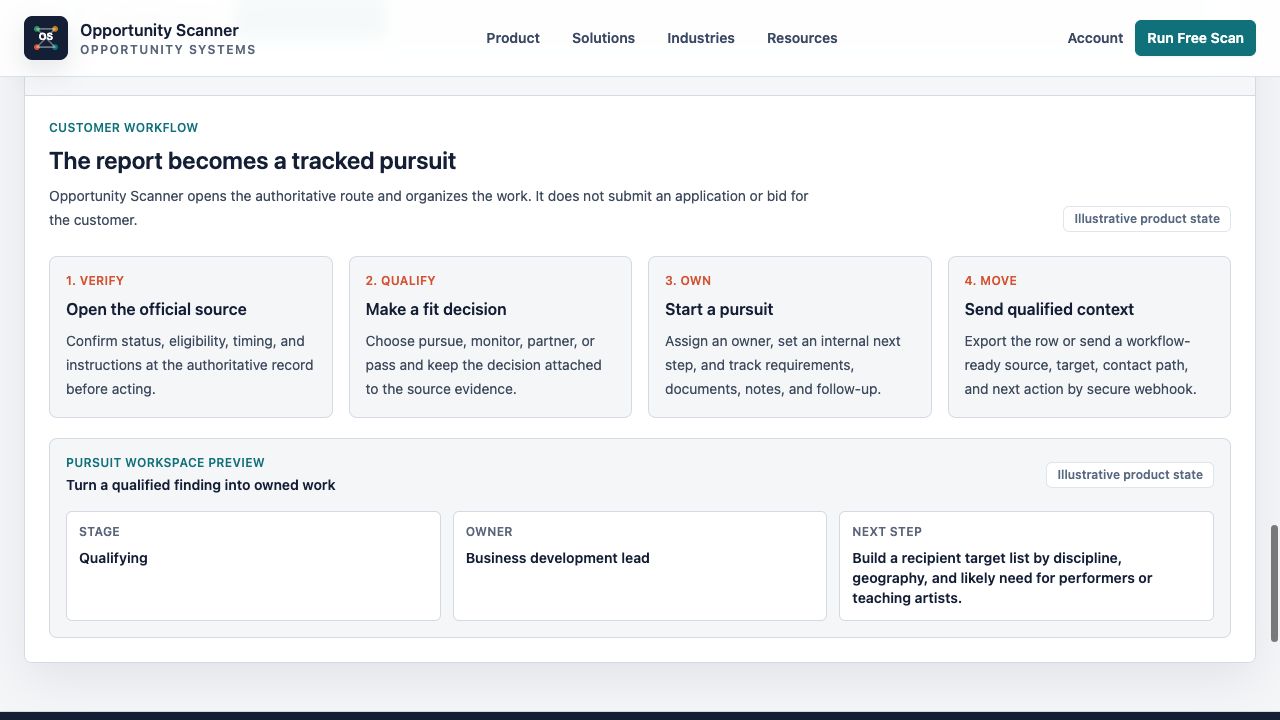
Do not wait for a specialized GovCon stack. Send qualified rows into the CRM, a shared action table, or a webhook-driven workflow. Map the target to the account, preserve the official link in a source field, put the evidence and caveat in the note, and create one task with an owner and due date. Keep the opportunity's public deadline separate from the team's internal review date.
Use a weekly review to decide advance, monitor, redirect, or close. Advance means the route and next action remain credible. Monitor means the evidence is real but timing is early. Redirect means a direct pursuit should become a prime, recipient, or channel motion. Close means the fit, eligibility, capacity, or route failed. Closed rows still teach the search model what not to surface.
An illustrative action row might connect a USAspending award to a named recipient, classify the motion as Sell to Award Recipient, route research to the recipient's official procurement page, and assign an owner to verify whether the funded program needs the company's service. The illustration claims no response, meeting, contract, or revenue result.
Measure whether the channel deserves more investment
Review operational evidence rather than vanity volume: how many rows survived qualification, how many had a credible route, how quickly owners completed the first action, and which motions repeatedly appeared. Do not publish conversion or revenue benchmarks until the product has enough measured data and a defined denominator.
Invest further when official records repeatedly show the same buyer problem, the company can meet likely requirements, and owners can execute the recommended route. Narrow when one segment works better than the rest. Partner or subcontract when direct pursuit is unrealistic. Stop when the source set repeatedly fails fit, eligibility, capacity, or timing. A disciplined stop decision is a successful market test, not a content failure.
Deal-flow qualification checklist
- 1Define the commercial offer, public buyer problem, search language, and exclusions.
- 2Identify whether the record is active procurement, historical spending, funding, forecast, policy, or recipient evidence.
- 3Preserve the official source URL, date, identifier, and status.
- 4Name the agency, recipient, prime, partner, or program that could become the target.
- 5Select one revenue motion and explain why it fits.
- 6Choose an official or verified contact path before enrichment.
- 7Assign one owner, next action, and internal due date.
- 8Record the condition that would disqualify or redirect the row.
- 9Review advance, monitor, redirect, and close decisions every week.
Charts and visual evidence
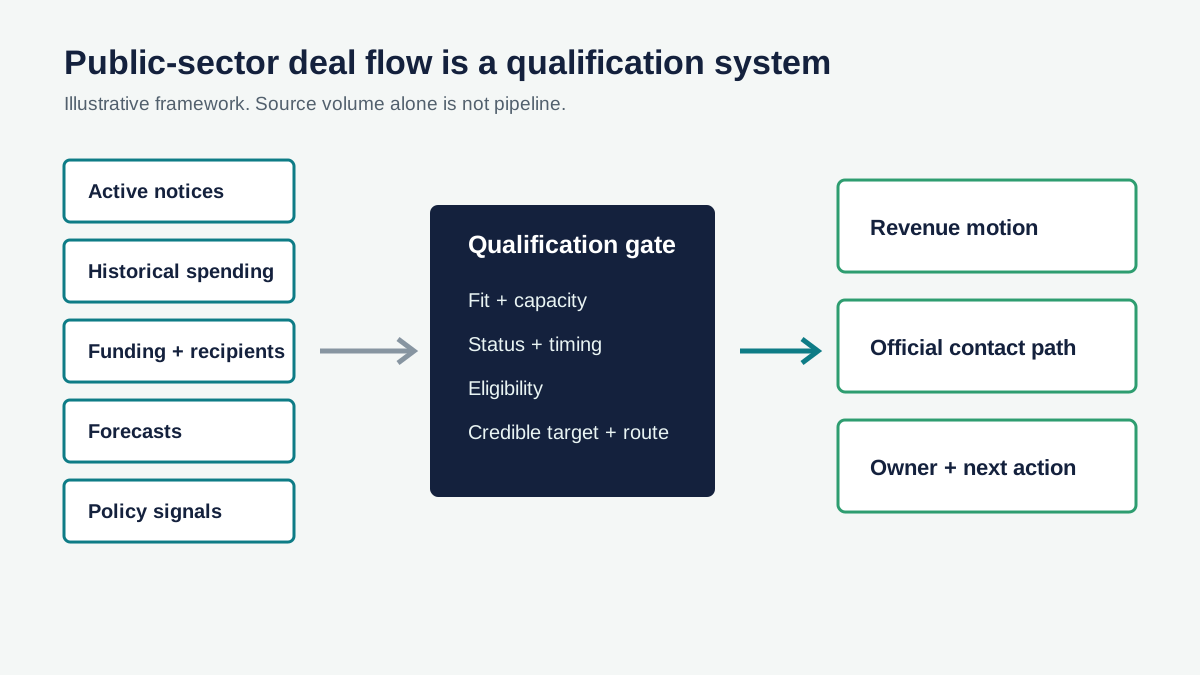
Illustrative public-sector deal-flow operating system
Five evidence lanes become pipeline only after qualification, routing, and ownership.
Open visual full sizeIllustrative framework. Source records require independent verification before pursuit. Source: Illustrative Opportunity Scanner framework informed by SBA, SAM.gov, USAspending, Grants.gov, and Acquisition.gov guidance; no measured performance claim.
Sources cited
Put this into the product
Run an Opportunity Scan to turn relevant public records into qualified, source-backed action rows.
Opportunity Scanner classifies the evidence, opens the official route, and lets you start a pursuit with an owner, fit decision, next step, internal due date, and notes.
Scan Your Company WebsiteKeep exploring
Related reads
Public-Sector Sales
Why Government Spending Is an Overlooked Growth Channel for Businesses
A practical guide to using contracts, awards, grants, recipients, and forecasts as evidence for new public-sector revenue paths.
7 min read
Public-Sector Sales
How to Build a Public-Sector Sales Pipeline Without a GovCon Team
A practical 30-day market test for companies that want to validate public-sector demand before hiring a capture team.
10 min read
Public-Sector Sales
How to Use Sample Opportunity Reports to Plan Public-Sector Outreach
Use industry sample reports to evaluate public-sector fit, understand opportunity evidence, and plan more relevant outreach.
6 min read