
Government Communications and Public Outreach Contracts: How to Qualify the Work
A practical guide to qualifying government communications, public outreach, advertising, media buying, research, creative, video, and campaign-support contracts.
Quick answer
The short answer
Government communications work can support recruitment, public safety, health, transportation, benefits, emergency response, public participation, and agency mission awareness. The opportunity may be a direct campaign procurement, a specialist subcontract under a larger program, or a funded recipient's engagement requirement. It may also be only a sources-sought notice or operational plan. Communications firms need to read the acquisition stage, delivery scope, audience, compliance obligations, and contact route before treating the record as pipeline.
Key takeaways
- A solicitation, sources-sought notice, historical award, and outreach requirement inside a grant are different commercial events.
- Qualify the full delivery chain: audience research, message strategy, creative, production, media, outreach, accessibility, measurement, and reporting.
- Use source-native contracting contacts for direct procurements and verified supplier or small-business routes for prime outreach.
- Public-interest communication requires careful claims, accessibility, language access, privacy, approvals, and performance evidence; a general portfolio is not enough.
Define the public objective before the channel mix
Public communications is usually tied to a mission outcome rather than commercial brand growth. An agency may need to recruit personnel, explain a benefit, improve emergency preparedness, gather public input, announce a safety change, reach a specific community, or increase completion of a public service. The source record should identify the objective, responsible office, target audience, geography, timing, and required deliverables.
GSA's advertising service description includes public awareness of agency missions, explanation of complex issues, information dissemination, and recruitment campaigns. Its public relations description includes message strategy, media materials, press activity, and monitoring. These categories are useful vocabulary, but a live requirement may bundle or separate them in a different way.
Before searching, write a capability matrix that distinguishes research, strategy, community engagement, creative, copy, multilingual production, video, paid media, social, earned media, events, web, analytics, and reporting. Mark what the firm self-performs, what a documented partner performs, and what is outside scope.
Read the notice type and deadline literally
A sources-sought notice is often a request for capability information that helps an agency shape acquisition strategy. It may influence set-aside and competition decisions, but it is not an offer request. The March 2026 Army Marketing and Advertising Services notice said it was market research for potential future requirements. Its response date passed, so it now supports future acquisition and partner monitoring, not a current response.
A combined synopsis/solicitation can be bid-oriented. The July 2026 Event Center Advertising notice was active at the July 13 review, contained a small-business set-aside and attachments, and listed a July 17 deadline. A separate July 2026 TXARNG promotional-items solicitation showed an updated July 24 deadline. These records demonstrate active demand in different slices of the market, not interchangeable fits for every agency.
Record the source's current label and the practical status. If a page says active but the offer date passed, mark the row deadline passed and verify whether an amendment reopened it. If a special notice describes sole-source intent, do not present it as open competition. If an RFI requests input, route it to capture or leadership instead of a proposal workflow.
Qualify the campaign delivery chain
Communications scopes often fail qualification at the edges. A firm may develop strategy and creative but lack media-buying authority, trafficking operations, production scale, event staffing, call-center capacity, print fulfillment, or regional placement access. Another may buy media but lack research, accessible content, or public-sector approval workflows. Review every deliverable and dependency rather than matching on the word advertising.
Media requirements need special attention. Capture markets, channels, estimated impressions or placements, make-goods, invoicing, commissions, brand safety, government-furnished materials, approval timing, performance reporting, and any requirement to return or credit commissions. GSA's Schedule descriptions explicitly address commissions in marketing and public-relations services, which signals why pricing and media cost treatment must be read closely.
Content and video scopes also carry production detail: scripting, talent, releases, location, animation, editing, captioning, audio description, translation, versioning, file formats, streaming, archiving, and usage rights. GSA's video-production category names many of these activities. The team should not infer that a social-content portfolio covers broadcast, public meeting, or accessibility deliverables.
Treat audience access as part of performance
Public outreach may need to reach people with disabilities, limited English proficiency, low connectivity, low literacy, or limited trust in the institution. The solicitation or recipient plan may specify languages, accessible formats, community partners, geographic coverage, and approval standards. If it does not, those issues may still need clarification during the authorized question period.
Do not reduce community engagement to media impressions. DOT's SS4A planning guidance includes stakeholder engagement, public meetings, interviews, surveys, comments, progress reporting, and public deliverables. A communications firm supporting a recipient may need facilitation, documentation, accessible materials, data handling, and a feedback loop that informs the plan, not only promotional creative.
Measurement should follow the objective. Recruitment work may track qualified actions; public-service campaigns may track reach, comprehension, task completion, event participation, or response; engagement work may track representation, themes, and documented incorporation of feedback. Use only metrics the source permits and the delivery system can substantiate.
Find prime and recipient routes without overclaiming
Large integrated communications programs may be held by a prime while specialist agencies perform regional media, language, production, research, outreach, or digital work. USAspending can identify historical prime and subaward records. SBA's prime and subcontracting resources can identify official supplier paths. Neither source proves that a slot is open.
A useful prime row names the award or procurement, current period, supported mission, the prime's official partner route, and one evidenced capability gap. The first action may be supplier registration or a small-business liaison introduction. Personal contact enrichment comes later and should not bypass a portal, notice contact, or formal teaming instruction.
Funded recipients require similar restraint. A grant can establish that a city, Tribe, nonprofit, university, or other entity has money for a public objective. It does not establish that communications is an allowable cost, outsourced, unprocured, or within the firm's geography. Verify award purpose, grant agreement or official program page, recipient plan, local procurement rules, and current implementation evidence.
Run a communications-specific bid and outreach gate
For direct procurement, score mission fit, audience experience, comparable performance, scope coverage, team availability, set-aside and registration, geography, media and production capacity, required partners, accessibility and language evidence, security or privacy, schedule, pricing feasibility, and response burden. One fatal gap should stop pursuit even when the creative brief is attractive.
For recipient or prime outreach, require a verified organization, source record, current program or contract context, plausible need, authorized route, and a narrow offer. The CRM note should state what the evidence proves and what remains unknown. Outreach should never say the prospect has a budget for your service unless an official current source supports that statement.
Keep an evidence refresh cadence. Recheck active notices daily near deadlines, monitor sources-sought and forecasts on a scheduled basis, review award records by period of performance, and revisit funded recipients when procurement or implementation plans appear. Close or downgrade rows when the evidence changes.
Government communications pursuit checklist
- 1Name the public objective, responsible office, audience, geography, and required outcome.
- 2Confirm notice type, current status, latest amendment, deadline, and authorized response route.
- 3Break the scope into research, strategy, creative, content, video, media, outreach, web, measurement, and reporting.
- 4Mark self-performed, partner-delivered, and unsupported capabilities.
- 5Check set-aside, registration, vehicle, place of performance, past performance, staffing, and schedule.
- 6Review media commissions, pass-through costs, rights, approvals, privacy, and reporting requirements.
- 7Validate accessibility, language, community-engagement, and production obligations.
- 8For primes and recipients, verify a current need and use the official partner or procurement route.
- 9Keep expired research notices and historical awards out of active bid counts.
- 10Write one next action and one disqualifier before assigning an owner.
Sources cited
Put this into the product
Run a scan to qualify communications and outreach records by status, scope, buyer route, and next action.
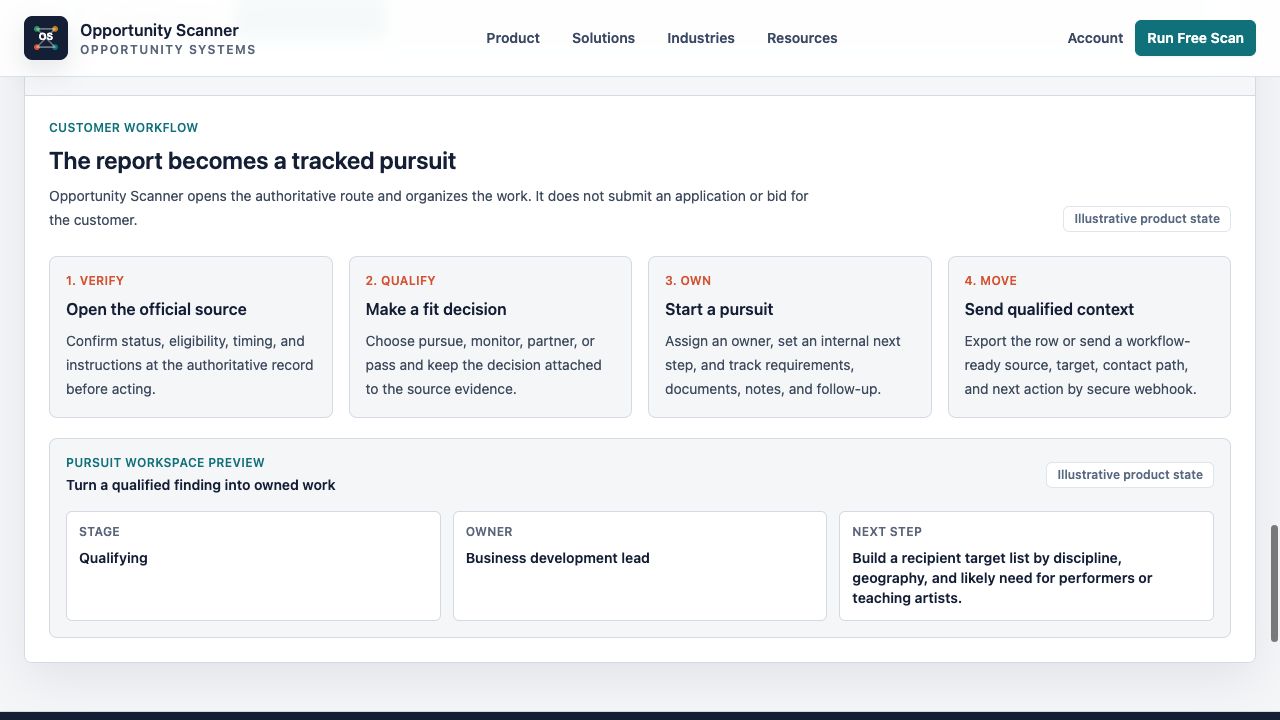
Opportunity Scanner classifies the evidence, opens the official route, and lets you start a pursuit with an owner, fit decision, next step, internal due date, and notes.
Scan Your Company WebsiteKeep exploring
Related reads
Industry Guides
Infrastructure Opportunities for Construction Companies
A source-backed workflow for finding infrastructure projects, public owners, funded recipients, primes, subcontracting routes, and supplier demand.
7 min read
Industry Guides
Clean Energy Public-Sector Opportunities
How clean-energy and facilities companies can distinguish grants, rebates, procurement, policy, funded buyers, and implementation routes.
7 min read
Industry Guides
Manufacturing and Supply Chain Public-Sector Demand
A practical source-to-action guide for manufacturers, suppliers, logistics providers, and industrial service companies pursuing public-sector demand.
7 min read