Education and Workforce Opportunity Signals for EdTech, Training, and Staffing Companies
A source-backed framework for EdTech, training, staffing, and education-service companies evaluating districts, workforce boards, agencies, providers, and funded recipients.
Quick answer
The short answer
Education and workforce opportunity is distributed across school districts, state agencies, local workforce boards, colleges, training providers, nonprofits, employers, and grant-funded intermediaries. A funding notice, district profile, labor-market projection, workforce plan, and procurement record answer different questions. The useful work is to combine them without pretending that evidence of need is the same as an open purchase.
Key takeaways
- Use education and labor data to qualify markets and targets, while keeping descriptive data separate from active procurement.
- Formula funds, discretionary grants, workforce programs, and district purchases create different buyer and partner routes.
- Commercial companies should not claim Direct Apply when a notice limits eligibility to states, districts, boards, nonprofits, or institutions.
- Every retained signal needs a verified target, revenue motion, role-specific contact path, next action, owner, and disqualifier.
From real scans — public records surfaced by Opportunity Scanner
Funded-buyer evidence from a real education / workforce / training scan
Historical public award records surfaced for an arts-educator staffing platform born out of California Prop 28. As of .
$9,954,119
Historical award - 2011
- Recipient
- Westat, Inc.
- Agency
- Dept. of Education
- Source system
- USAspending award record
K-12 hiring, teacher staffing, and educator workforce work. Staffing intermediaries can receive educator-workforce funding outside a direct district sale.
$547,714
Historical award - 2018
- Recipient
- FM Talent Source, LLC
- Agency
- Dept. of Education
- Source system
- USAspending award record
arts education and teaching-artist staffing. Teaching-artist staffing can enter through recipient partnerships as well as district procurement.
Education and workforce records answer different questions
A Department of Education grant forecast can show that an agency expects to invite applications. Grants.gov and the final notice establish status and eligibility. NCES data can identify public schools, districts, enrollment, staffing, and finances. DOL workforce records can identify state plans, local areas, American Job Centers, grants, and program priorities. BLS data can describe occupational employment and projections. None of these sources alone proves that a specific district or board is ready to buy.
Use each source for the question it can support. Descriptive data helps define a target market. Award data identifies a funded organization and program purpose. A forecast supports monitoring. An active solicitation creates a procurement action. A public plan can reveal a mission problem and responsible body. The action table should preserve the source type so sellers know whether they are looking at demand evidence, a funded-buyer hypothesis, or a current response path.
This discipline matters for EdTech, staffing, professional learning, curriculum, arts education, credentialing, apprenticeship, recruitment, and student-support companies. These offers may fit several systems, but fit must be explicit in the record rather than inferred from a broad keyword like education or workforce.
Separate formula funding, competitive grants, and procurement
The Department of Education distinguishes discretionary grants, which use a competitive process, from formula grants distributed to state or local governments under legislated formulas. A formula allocation can help explain where money moved, but the commercial action usually happens later through a state plan, district budget, grant administration, contract, or funded-provider program. Calling the allocation itself an open vendor opportunity skips the decision-making layer.
A competitive grant has its own eligibility. A current program may allow only state educational agencies, local educational agencies, institutions, nonprofits, or another defined group. If a commercial training or software company is not eligible, the motion is not Direct Apply. The company may monitor official awards, research likely implementation partners, or pursue an authorized vendor route after a recipient and need are verified.
Procurement records are different. A district RFP, state contract, workforce-board solicitation, or college purchasing notice can support Sell to Agency or Sell to Public Institution when the offer, timing, geography, and vendor requirements fit. Preserve the portal, solicitation number, addenda, response deadline, and official contact. Do not replace the source-native route with generic contact enrichment.
Use NCES to define the buyer universe, not buying intent
NCES describes the Common Core of Data as the primary federal database on public elementary and secondary schools and education agencies. It includes annual descriptive information about schools, districts, students, staff, revenues, and expenditures. That makes CCD useful for identifying official district entities, NCES IDs, size, geography, school counts, and basic fiscal context.
Those fields can improve targeting. A staffing provider can segment districts by location and size; an arts-education company can identify grade spans; an EdTech company can validate the official agency entity before matching procurement records. But a district's enrollment, expenditure, or staffing count does not prove a current vendor need. The row should use Research Only until a plan, budget, grant, board action, or procurement source adds evidence of demand.
State and local source review completes the picture. District board agendas, adopted budgets, procurement portals, state contract systems, workforce-board plans, eligible-training-provider information, and official award notices often provide the actionable layer. Because formats and rules vary by jurisdiction, the report should link to the exact source and name what it proves.
Map workforce demand without overstating projections
BLS projects total employment and occupational openings using a national employment model. Its 2024-2034 tables include employment change, annual average openings, wages, education, work experience, and training requirements by occupation. Those fields can help identify where training capacity, recruiting, credentialing, or career-navigation questions may be important. BLS also cautions that projections are subject to uncertainty and should not be the sole basis for decisions.
A projection is therefore a market signal, not a funded program. Combine it with state or local plans, WIOA priorities, employer evidence, grants, and procurement records. A high-growth occupation can justify research into local workforce boards or community colleges, but it does not identify a buyer by itself. Keep the data year, geography, occupation code, and methodological caveat visible.
WIOA creates a coordinated public workforce system involving states, local areas, nonprofits, grantees, education agencies, and American Job Centers. DOL notes that state plans align core programs and that local and regional collaboration is part of the system. For commercial companies, credible routes may include Sell to Agency, Sell to Funded Buyer, Partner with Recipient, or Monitor Policy depending on the specific plan, award, board, or solicitation.
Choose the right target and contact path
Education and workforce buyers are role-specific. A district technology procurement may route through the purchasing office and technology leadership. Staffing may involve HR and an approved vendor process. Professional learning can involve curriculum, student services, special education, or a grant program. A workforce initiative may route through a local board, fiscal agent, American Job Center operator, college, recipient nonprofit, or employer partnership.
Start with the official record. For an RFP, use the named procurement contact and question process. For a grant, use the program contact for eligibility questions and wait for official awards before labeling recipients as funded. For a public plan, identify the responsible agency or board and assign research or monitoring. For a named funded provider, verify the award purpose and public vendor or partnership route before enriching individuals.
A real Opportunity Scanner scan for an arts-educator staffing platform born out of California Prop 28 surfaced 21 sourced signals across 11 federal agencies and two source systems. Historical award evidence showed that educator-workforce money had flowed to staffing intermediaries as well as public institutions: Westat, Inc. received a $9,954,119 Department of Education award in 2011 for K-12 hiring, teacher staffing, and educator workforce work, while FM Talent Source, LLC received a $547,714 Department of Education award in 2018 tied to arts education and teaching-artist staffing. These records supported funded-buyer and recipient-partner research; they did not establish a current staffing request, open application, or purchasing cycle.
Build an education and workforce Opportunity Action Table
Each retained row should include source URL and date, target entity and entity type, geography, learner or worker population, program purpose, funding or procurement status, eligibility, revenue motion, contact path, next action, owner, due date, and disqualifier. Add occupation codes, district IDs, award numbers, or solicitation identifiers when they materially improve verification.
Use Direct Apply only when the company or its eligible entity can legally apply and the program fits. Use Sell to Agency for a public buyer, Sell to Funded Buyer for a verified recipient with a plausible purchase path, Partner with Recipient for a complementary delivery role, and Channel / Distributor Motion when an intermediary or approved provider is the realistic route. Use Monitor Policy for plans and forecasts, and Research Only for descriptive data or incomplete evidence.
Opportunity Scanner should reduce a large education-data universe to a small set of defensible actions. It connects the company's actual offer to official source language, verifies the organization and program context, and gives the revenue team a route that respects public purchasing and grant rules.
Education and workforce qualification checklist
- 1Define the offer, learner or worker population, geography, delivery model, and public outcome.
- 2Identify whether the source is descriptive data, a plan, forecast, grant, award, budget, board action, or procurement.
- 3Verify the official district, agency, board, institution, or provider entity before creating a target.
- 4Read the controlling eligibility language before assigning Direct Apply.
- 5Keep formula allocations separate from discretionary grants and vendor solicitations.
- 6Use NCES identifiers and context for targeting, not as evidence of buying intent.
- 7Keep BLS projection years, geography, occupation codes, and uncertainty caveats visible.
- 8Check state, district, college, and local workforce-board sources for the actionable layer.
- 9Use source-native procurement and program contacts before paid enrichment.
- 10Assign one motion, one next action, one owner, and one disqualifier to each retained row.
Charts and visual evidence
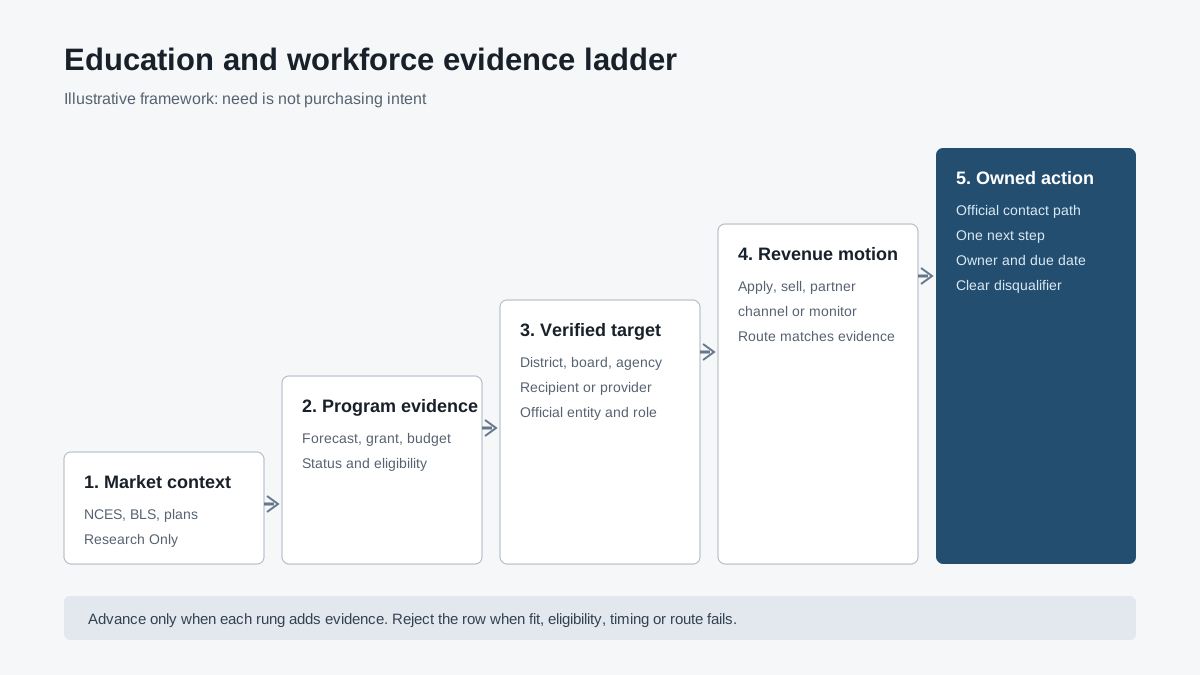
Education and workforce evidence ladder
Descriptive need becomes a sales action only after a verified program, target, and authorized route are added.
Open visual full sizeIllustrative evidence framework; it does not represent measured pipeline conversion. Source: Illustrative Opportunity Scanner framework informed by ED, NCES, DOL, BLS, Grants.gov, and state/local source structures
Sources cited
Put this into the product
Run a free scan to turn your education or workforce offer into qualified district, agency, board, provider, and funded-recipient action rows.
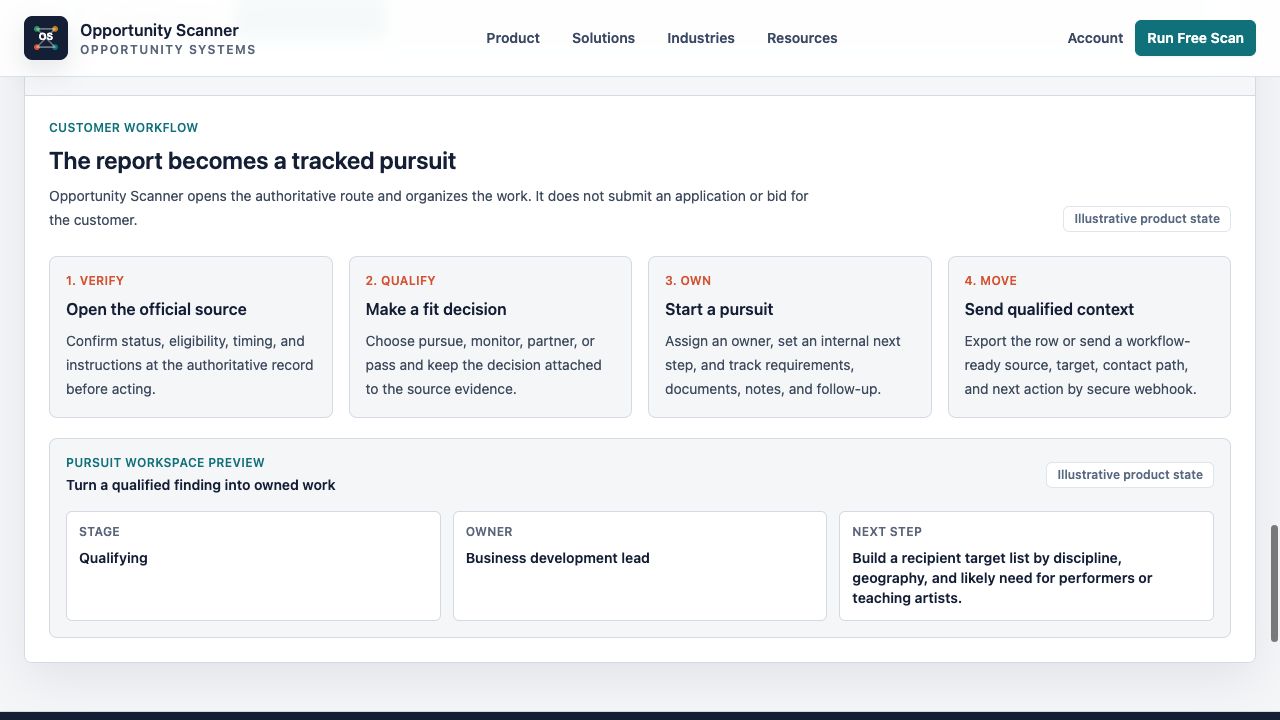
Opportunity Scanner classifies the evidence, opens the official route, and lets you start a pursuit with an owner, fit decision, next step, internal due date, and notes.
Scan Your Company WebsiteKeep exploring
Related reads
Industry Guides
Infrastructure Opportunities for Construction Companies
A source-backed workflow for finding infrastructure projects, public owners, funded recipients, primes, subcontracting routes, and supplier demand.
7 min read
Industry Guides
Clean Energy Public-Sector Opportunities
How clean-energy and facilities companies can distinguish grants, rebates, procurement, policy, funded buyers, and implementation routes.
7 min read
Industry Guides
Manufacturing and Supply Chain Public-Sector Demand
A practical source-to-action guide for manufacturers, suppliers, logistics providers, and industrial service companies pursuing public-sector demand.
7 min read