Creative Economy Funding: Arts Grants, City Events, Tourism, and Parks Opportunities
A practical source-backed guide to arts grants, cultural procurement, city events, tourism programs, parks opportunities, and funded creative-economy partners.
Quick answer
The short answer
Creative-economy opportunity is much broader than an artist grant search. Public money can move through cultural agencies, city event contracts, parks programming, tourism organizations, libraries, museums, schools, local arts agencies, and nonprofit recipients. The commercial question is not simply where funding exists. It is which organization controls the work, whether your company is eligible, what revenue motion fits, who the authorized contact is, and what evidence supports the next action.
Key takeaways
- Separate direct grants from procurement, subgrants, funded recipients, venue or event buying, and cultural-policy signals.
- For-profit creative businesses are often ineligible for major arts grants but may still have credible vendor, partner, or channel routes.
- State, regional, and local arts systems matter because federal cultural funding is distributed through multiple layers.
- Build outreach around the funded public objective and verified source record, not a generic request for support.
From real scans — public records surfaced by Opportunity Scanner
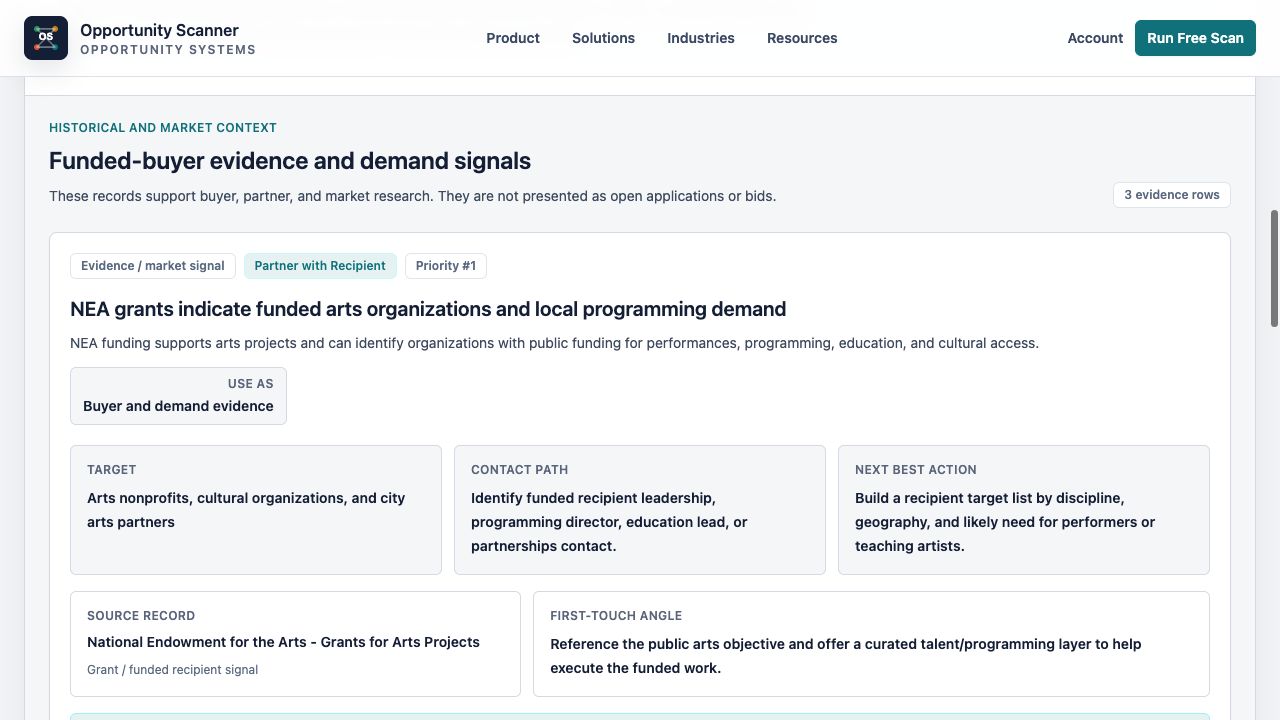
Funded-buyer evidence from a real arts / creative economy / live events scan
Historical public award records surfaced for a musician-booking marketplace. As of .
$24,000,000
Historical award - 2018
- Recipient
- John F. Kennedy Center for the Performing Arts
- Agency
- Dept. of Education
- Source system
- USAspending award record
arts and culture grant. Cultural institutions can be funded buyers or channel partners, not only grant makers.
$9,267,988
Historical award - 2022
- Recipient
- Hargrove, LLC
- Agency
- Dept. of State
- Source system
- USAspending award record
cultural programming and live events. Direct event contractors create a distinct public-sector sell and partner motion.
$1,152,925
Historical award - 2018
- Recipient
- Isom Events LLC
- Agency
- Dept. of the Interior
- Source system
- USAspending award record
city/county live performance work. Local live-performance work creates a contractor route beyond federal arts agencies.
The creative economy is a market, not a single funding program
The Bureau of Economic Analysis reported that arts and cultural economic activity accounted for 4.2 percent of U.S. GDP, or $1.17 trillion, in 2023. BEA also states that it will no longer regularly produce the Arts and Cultural Production Satellite Account, so that figure should be labeled with its data year rather than repeated as a current annual estimate. It demonstrates category scale, not available grant money or addressable revenue for any one company.
Inside that broad economy, public-sector signals have different commercial meanings. A city festival solicitation can be a Sell to Agency record. An NEA award to a nonprofit can become funded-recipient research. A state arts-agency program may create Direct Apply eligibility for one organization and a future partner lane for another. A tourism plan or parks calendar may be early evidence that requires monitoring until an official budget, procurement, or partner request appears.
A strong opportunity report preserves those distinctions. It should never turn every arts-related record into a grant lead or imply that the funder is the buyer. The target may be a cultural affairs office, destination organization, library, museum, school district, parks department, local arts agency, awarded nonprofit, venue operator, or prime event producer.
Check eligibility before choosing Direct Apply
NEA Grants for Arts Projects currently identifies eligible applicants as nonprofit tax-exempt organizations, units of state or local government, and federally recognized tribal communities or tribes, subject to program rules. The program page explicitly excludes commercial for-profit enterprises. For a music technology company, booking platform, production business, agency, or other commercial operator, that means the federal record should not automatically receive a Direct Apply motion.
The same principle applies across Grants.gov: every opportunity's application instructions control legal eligibility. Some programs permit businesses; many cultural programs do not. A company should record the eligible entity types, required history, cost share, deadlines, and project rules before investing in an application plan or advising a client that it can apply.
Ineligibility does not make the record useless. It changes the route. An eligible nonprofit or public entity may need performers, teaching artists, production, accessibility support, venue services, ticketing, marketing, technology, evaluation, or community engagement. That potential should remain Research Only until an official recipient or procurement path exists, then advance to Sell to Funded Buyer or Partner with Recipient only when the need is credible.
Follow funding through the federal, state, regional, and local layers
The NEA says its partnership grants go to 56 state and jurisdictional arts agencies and six regional arts organizations. Those organizations distribute support and run programs responsive to state and regional priorities. This makes the NEA's official state and regional directory a practical source map, not merely a contact list. A creative company should review the relevant agency's current programs, award lists, public notices, and vendor procedures.
Local arts agencies, cultural affairs departments, and city or county procurement systems add another layer. Their records can point to public art administration, event production, artist rosters, neighborhood programming, cultural facilities, creative workforce initiatives, and grant administration. State and local rules vary, so the action row must link to the actual jurisdiction's source and preserve registration, insurance, accessibility, and deadline requirements when published.
Federal award history can help connect the layers. USAspending and agency award databases can identify recipients and award purposes, while NEA, NEH, and IMLS maintain program and award information. An award is historical money movement, not proof of an open subcontract. Use it to validate the ecosystem, identify a named organization, and assign a next step to review that organization's public plans or purchasing route.
Distinguish arts, humanities, museums, libraries, and tourism routes
NEH supports museums, historic sites, colleges, universities, K-12 teachers, libraries, public media, research institutions, scholars, and nonprofits through multiple grant programs. IMLS programs have their own eligibility rules for museums, libraries, and tribal organizations, and IMLS notes that ineligible organizations may sometimes participate through partnerships. These are adjacent ecosystems, but they should not be collapsed into one generic arts grant category.
A museum technology vendor might use an IMLS award as funded-institution research. A documentary or public-programming organization may evaluate an NEH opportunity under its specific rules. A live-event company may find a city procurement or destination-marketing partner more commercially relevant than either. The report should state which public objective the source supports: preservation, public programming, education, workforce development, access, tourism, or civic engagement.
Tourism and parks opportunities are especially local. Look for official destination plans, event calendars, parks solicitations, council budgets, cultural district documents, and awarded vendor records. A calendar item alone is not a solicitation, and a strategic plan is not budget authority. Those can be Monitor Policy or Research Only signals until a procurement, sponsorship process, program contact, or funded operator provides a defensible route.
Match the contact path to the operating model
A grant opportunity routes to the application instructions and program contact. A city solicitation routes to the procurement portal and named contracting contact. A funded nonprofit may route to its program, operations, partnerships, or production leadership. A school arts program may route through district procurement, enrichment, curriculum, or a lead nonprofit. The right route depends on who owns the work and what the source authorizes.
A real Opportunity Scanner scan for a musician-booking marketplace surfaced 28 sourced signals across nine federal agencies and three source systems. Historical award evidence showed several distinct routes: the John F. Kennedy Center for the Performing Arts received a $24,000,000 Department of Education arts and culture grant in 2018; Hargrove, LLC received a $9,267,988 Department of State award in 2022 for cultural programming and live events; Isom Events LLC received a $1,152,925 Department of the Interior award in 2018 for city and county live-performance work; and Chevo Studios Inc. received a $381,588 Department of the Interior award in 2023 for creative workforce development. These records supported funded-buyer, contractor, and partner research. They did not establish that any recipient was currently purchasing or accepting proposals.
Avoid outreach that claims access to public money or asks a recipient to redirect restricted funds. The first message should demonstrate that the team understands the project, timing, audience, and delivery requirement. Where no official purchasing or partnership route exists, keep the row in research rather than enriching personal contacts.
Turn cultural records into an Opportunity Action Table
Each creative-economy row should include the official source, source date, geography, program or event, funder, target organization, eligible applicant types, award or procurement status, public objective, revenue motion, contact path, next action, owner, due date, and disqualifier. For funded-recipient rows, distinguish the funder from the organization that may buy or partner.
Use the full motion set. Direct Apply is appropriate only when eligibility and fit are credible. Sell to Agency applies to a public buyer with an official route. Sell to Funded Buyer and Partner with Recipient require a verified recipient and plausible need. Channel / Distributor Motion can fit a prime producer, venue network, or implementation partner. Monitor Policy fits cultural plans and future cycles. Research Only holds award history and incomplete evidence without inflating pipeline.
Opportunity Scanner connects the creative company's capabilities to public-language terms, finds source evidence, and turns each defensible record into a target, motion, contact path, and owned next action. The value is a smaller, truer pipeline that recognizes how creative work is actually funded and purchased.
Creative-economy source-to-action checklist
- 1Define the creative service, delivery format, geography, audience, and public objective.
- 2Classify the source as a grant, procurement, award, subgrant program, event plan, tourism signal, or funded recipient.
- 3Read the official eligibility and application instructions before assigning Direct Apply.
- 4Separate the funder, eligible applicant, recipient, buyer, and delivery partner in the action row.
- 5Check state, regional, and local arts-agency sources in addition to federal programs.
- 6Search the relevant city's procurement, parks, tourism, cultural affairs, and school systems for official routes.
- 7Preserve award purpose and restrictions; do not assume a recipient can or will hire outside vendors.
- 8Tie outreach to the public objective and relevant delivery evidence rather than a generic creative pitch.
- 9Use official program or procurement contacts before third-party personal-contact enrichment.
- 10Reject expired, ineligible, geographically impossible, or route-less records instead of padding the pipeline.
Charts and visual evidence
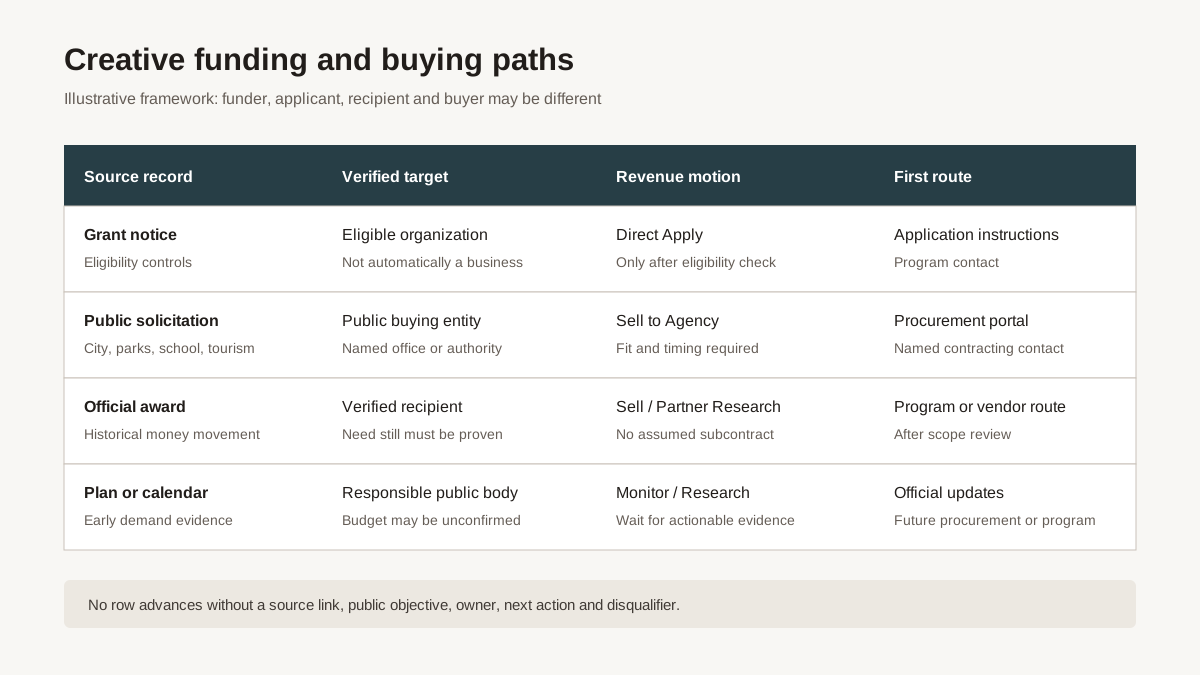
Creative funding and buying paths
The funder, applicant, recipient, buyer, and delivery partner may be different organizations and require different actions.
Open visual full sizeIllustrative routing framework; it does not represent measured award or sales outcomes. Source: Illustrative Opportunity Scanner framework informed by NEA, NEH, IMLS, Grants.gov, USAspending, and state/local source structures
Sources cited
Put this into the product
Run a free scan to turn your creative offer and official cultural records into qualified grant, buyer, partner, event, and monitoring actions.
Opportunity Scanner classifies the evidence, opens the official route, and lets you start a pursuit with an owner, fit decision, next step, internal due date, and notes.
Scan Your Company WebsiteKeep exploring
Related reads
Industry Guides
Infrastructure Opportunities for Construction Companies
A source-backed workflow for finding infrastructure projects, public owners, funded recipients, primes, subcontracting routes, and supplier demand.
7 min read
Industry Guides
Clean Energy Public-Sector Opportunities
How clean-energy and facilities companies can distinguish grants, rebates, procurement, policy, funded buyers, and implementation routes.
7 min read
Industry Guides
Manufacturing and Supply Chain Public-Sector Demand
A practical source-to-action guide for manufacturers, suppliers, logistics providers, and industrial service companies pursuing public-sector demand.
7 min read