
What a Public-Sector Opportunity Report Should Include
The fields, evidence, qualification logic, and workflow controls that turn public-sector research into an Opportunity Action Table.
Quick answer
The short answer
A public-sector opportunity report should do more than summarize agencies, grants, and contracts. It should let a busy operator decide what is real, what fits, who the target is, which revenue motion applies, how to approach the opportunity, and who owns the next step. That requires an auditable evidence layer and a practical action layer, with historical spending kept separate from active opportunities.
Key takeaways
- Every conclusion should trace to an official record and retrieval date.
- Evidence, commercial interpretation, and recommended action should be separate fields.
- A report becomes operational when rows have motions, routes, owners, due dates, and disqualifiers.
Begin with an evidence contract
Every row should preserve source name, source URL, source date, retrieval date, record identifier, record type, status, and a concise evidence excerpt or summary. Those fields let a reviewer reopen the record and understand whether it changed. They also reduce duplicate rows when the same notice or award appears through multiple searches.
The report must state what the source proves and what it does not. USAspending award data is historical money-flow evidence, not an open solicitation. A Grants.gov forecast is planned and not guaranteed to post. A SAM.gov Sources Sought notice can invite market research responses without being an offer request. These distinctions belong in the row, not in fine print elsewhere.
Use current official sources as the factual layer. Third-party summaries can support discovery, but the public record should remain linked when available. Record caveats such as stale status, incomplete descriptions, data-quality limits, and inferred organization matches.
Describe the opportunity in business terms
The interpretation layer should include an evidence summary, why it matters to this company, target organization, buyer or partner type, opportunity lane, and fit rationale. It should translate government terminology into a commercial decision without rewriting uncertainty as certainty.
Separate target from source owner. The agency that issued a grant may not be the organization a commercial seller should pursue. The award recipient, prime contractor, subrecipient, school district, health provider, or program operator may be the practical target. Conversely, a historical recipient may be less useful than the agency's next forecast.
Include fit, confidence, and actionability as separate judgments. Fit asks whether the offer maps to the need. Confidence asks how strongly the source supports the interpretation. Actionability asks whether timing, eligibility, capacity, and route support a next action now. Explain the scores in words so they do not become unexplained precision.
Make the revenue motion explicit
Use a controlled set of motions: Direct Apply, Sell to Agency, Sell to Funded Buyer, Sell to Award Recipient, Partner with Recipient, Channel or Distributor Motion, Monitor Policy, and Research Only. One primary motion forces the report to say how value could move between the company and the target.
Direct Apply requires eligibility and a live or planned application path. Sell to Agency requires a procurement or market-engagement route. Recipient motions require verified recipient evidence and a plausible downstream need. Channel Motion requires a prime, distributor, reseller, or vehicle relationship. Monitor and Research keep valid but premature signals from inflating active pipeline.
Add a disqualifier and redirect rule. A grant may fail Direct Apply but redirect to Partner with Recipient. A federal procurement may fail capacity but redirect to a prime. A historical award may remain Research Only until a forecast or renewal signal appears.
Specify the contact strategy, not merely contact data
Contact fields should include route type, source-native contact, recommended office or role, official URL, response instructions, enrichment status, manual-research instruction, and confidence. The route may be a contracting officer, vendor portal, small-business office, program office, grant contact, recipient team, prime supplier page, or monitoring task.
FAR 15.201 makes the contracting officer the focal point after a solicitation release. That is a workflow rule the report should preserve. Before release, forecasts, industry liaisons, and small-business offices may support responsible engagement. For private recipients and primes, enrichment can help after the account and function are validated.
Do not show guessed personal emails as equivalent to official contacts. Keep provider, verification date, and suppression status with enriched data. A report that says 'manual research required' is more credible than one that invents certainty.
Add the action and workflow layer
Each row needs a next best action written as a concrete verb: review attachments, verify eligibility, respond to the notice, inspect the forecast, register as a vendor, map the prime, monitor awards, research the recipient, draft a capability statement, or close the row. Add an owner, internal due date, source deadline, status, and last-reviewed date.
For CRM use, preserve account name, opportunity title, source link, motion, evidence summary, outreach angle, contact strategy, owner, task date, and a CRM-ready note. Keep source deadlines distinct from sales follow-up dates. Include stable IDs so updates modify the same record instead of creating duplicates.
A free report can show a small number of real signals and the total found. The paid report should unlock the full action layer: all qualified rows, buyer and partner targets, source records, contact strategies, CRM notes, outreach angles, and workflow export. The paid value is not extra prose; it is reduced decision and execution work.
Include rejection logic and report-level context
A credible report shows why rows were excluded or downgraded. Common disqualifiers include weak keyword fit, expired timing, legal ineligibility, unrealistic delivery, unsupported recipient identity, duplicate records, no credible route, or a requirement outside the company's offer. Rejection reasons improve future searches and prevent weak rows from returning.
At report level, summarize the strongest demand lanes, common targets, motion mix, geographic limits, major caveats, and recommended first three actions. Explain whether the evidence supports immediate pursuit, recipient research, partner development, registration, monitoring, or a stop decision.
An illustrative row may connect an official award to a verified recipient, explain a possible implementation need, assign Sell to Funded Buyer, route to the recipient's procurement page, and task an owner to validate demand. The example must say that no need, meeting, response, or revenue result is assumed.
Add a source-coverage note so the reader knows which lanes were searched and which were not. A report based on federal sources should not imply complete state and local coverage. Acquisition.gov's forecast directory can document which agency planning pages were reviewed, while USAGov can anchor official agency identity and contact routes. Stating coverage limits is part of the product, not an apology.
Finally, include a freshness policy. Active notices should be checked close to action because amendments can change deadlines and instructions. Historical awards can remain useful longer but still need a retrieval date. Forecasts and grant plans should retain their planned status until an official posting changes it. The report should make stale evidence obvious before it reaches outreach or CRM workflow.
Opportunity report field checklist
- 1Source name, URL, date, retrieval date, identifier, type, and status.
- 2Evidence summary plus explicit caveat.
- 3Target organization and buyer or partner type.
- 4Why the record matters to this company.
- 5Primary revenue motion and redirect option.
- 6Fit, confidence, eligibility, and actionability rationale.
- 7Source-native contact, official route, recommended role, and enrichment status.
- 8Next action, owner, internal due date, source deadline, and status.
- 9Disqualifier and duplicate key.
- 10CRM note, outreach angle, and workflow-ready payload.
Charts and visual evidence
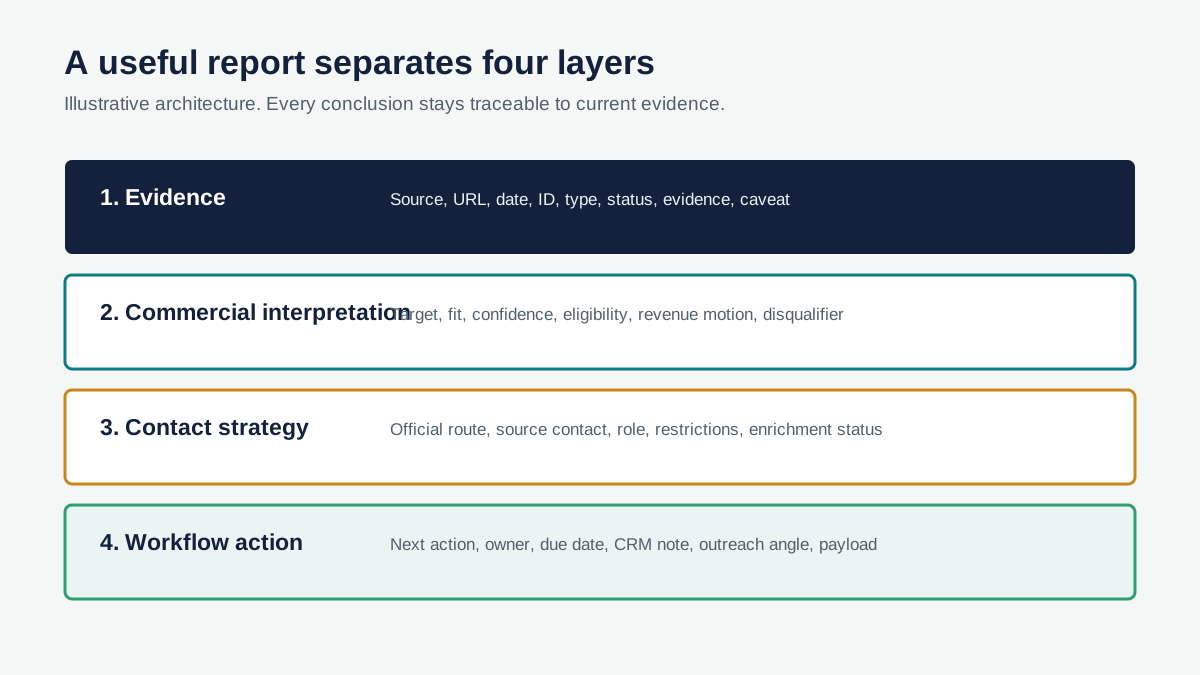
Illustrative anatomy of an Opportunity Action Table
Evidence, interpretation, route, and ownership remain distinct but connected.
Open visual full sizeIllustrative report architecture. Field values must remain traceable to current sources. Source: Illustrative Opportunity Scanner framework informed by official source-field and procurement guidance; no measured claim.
Sources cited
Put this into the product
View a sample report or run a scan to see official records translated into an Opportunity Action Table.
Opportunity Scanner classifies the evidence, opens the official route, and lets you start a pursuit with an owner, fit decision, next step, internal due date, and notes.
Scan Your Company WebsiteKeep exploring
Related reads
Opportunity Intelligence
What Is a Public-Sector Opportunity Signal?
Learn how to classify public-sector opportunity signals, reject weak matches, and turn credible evidence into a target and next action.
7 min read
Opportunity Intelligence
Grants vs Contracts vs Funded Buyers: What Businesses Should Actually Track
Understand when to apply, bid, sell to an agency, pursue a funded organization, partner with a recipient, or keep researching.
7 min read
Public-Sector Sales
Why Government Spending Is an Overlooked Growth Channel for Businesses
A practical guide to using contracts, awards, grants, recipients, and forecasts as evidence for new public-sector revenue paths.
7 min read