
Grants vs Contracts vs Funded Buyers: What Businesses Should Actually Track
Understand when to apply, bid, sell to an agency, pursue a funded organization, partner with a recipient, or keep researching.
Quick answer
The short answer
Grants, contracts, and funded buyers are often grouped together as government opportunities, but they create different legal relationships, targets, timelines, and sales actions. A contract is a purchase. A grant or cooperative agreement funds an authorized public purpose. A funded buyer or award recipient is an organization that received public money and may later need vendors or partners. Confusing the three produces predictable mistakes: bidding on a notice that is only market research, applying for funding the company cannot receive, or contacting a recipient before verifying its award and role. This guide turns each source into the right revenue motion.
Key takeaways
- Contracts buy products or services for a public buyer; assistance awards support a public purpose under the terms of the specific notice.
- Eligibility must be verified on the funding opportunity before assigning Direct Apply.
- A funded recipient can become a buyer, award-recipient target, or partner only after its award, purpose, timing, and plausible need are verified.
- Historical awards and forecasts are valuable market evidence but must remain separate from active opportunities.
Contracts create a buyer-supplier path
A government contract is used when an agency purchases products or services for its direct benefit or use. For federal opportunities, SAM.gov publishes notices from contracting offices. The notice type, status, attachments, response deadline, set-aside, NAICS code, place of performance, and official instructions determine whether a company has a credible pursuit.
Not every SAM.gov record is an open bid. Sources Sought notices and requests for information can support market research. Presolicitations can give early notice. Solicitations and combined synopsis or solicitation records may create a response path. Award notices document a result. A sales team should preserve the notice type rather than flattening every record into Government Contract.
The usual revenue motion is Sell to Agency when the company is pursuing the public buyer. It may become Channel or Distributor Motion or Sell to Award Recipient when a prime contractor or contract holder is the realistic route. Direct prime pursuit requires readiness, registration, fit, and enough time to comply with the actual instructions.
Grants create an applicant-program relationship
Federal grants and cooperative agreements provide financial assistance for an authorized public purpose. Grants.gov lets users filter by agency, category, instrument, eligibility, dates, and opportunity status. Posted opportunities are accepting applications. Forecasted opportunities are planned and not guaranteed to become official announcements. Closed and archived records are historical.
The opportunity notice controls eligibility. Grants.gov explains that eligible applicants may include government organizations, educational organizations, public housing organizations, nonprofits, for-profit organizations, small businesses, and individuals, but not every category is eligible for every opportunity. A broad search filter or topic match is not enough. Read the synopsis and application instructions before assigning Direct Apply.
Even an eligible applicant must assess program fit, cost sharing, performance period, reporting, allowable activities, and application effort. A grant is not ordinary sales revenue and should not be described as a purchase order. If the company cannot apply, the record may still support future recipient research, but only when a credible downstream vendor or partner role exists.
Funded buyers and recipients create an indirect route
USAspending defines a recipient broadly as a company, organization, individual, or government entity receiving federal funding. Recipient profiles and award records can reveal who received contracts or financial assistance, from which agency, for what broad purpose, in what place, and during what period. This is one of the strongest ways to move from a program name to a named organization.
A recipient is not automatically a buyer. A grant may fund salaries rather than outside vendors. A contract recipient may be delivering work with an established supply chain. An award may be old, modified, partially obligated, or unrelated to the company's offer. The report must preserve those caveats and validate award purpose before recommending outreach.
When the route is credible, choose among Sell to Funded Buyer, Sell to Award Recipient, Partner with Recipient, or Channel or Distributor Motion. Name the specific recipient and funded objective. Then identify a role such as program, operations, procurement, partnerships, supplier diversity, or implementation leadership. Use contact enrichment only after the organization and route are verified.
Keep timing and money definitions honest
Active means a response or application path is currently available under the official record. Forecasted means an agency expects or plans activity. Historical means an award, closed opportunity, or prior procurement can support market research but not a current response. Funded-recipient means an award identifies an organization, while its buyer or partner need remains a business hypothesis to validate.
USAspending distinguishes obligations from outlays. An obligation is a promise to spend; an outlay reflects payment. Award amounts may also include current and potential values. These fields should not be mixed in a chart or sales claim. The safest business-development use is to identify patterns, organizations, offices, award types, and timing, then return to the source record for specifics.
A forecast should carry a monitoring date and expected timing, not a fabricated deadline. A closed grant should not appear as available funding. An award should not appear as remaining budget. These small language choices protect both report credibility and the team's next action.
Use a source-to-motion decision tree
Start with the record type. If it is an active procurement, validate fit, readiness, notice type, and response instructions; then choose Sell to Agency or an indirect prime or channel route. If it is an active funding opportunity, validate legal eligibility and program fit; then choose Direct Apply or reject the direct path.
If the record names an award recipient, verify the award, purpose, period, and organization. Choose a funded-buyer, award-recipient, partner, or channel motion only when a plausible need follows from the funded work. If the record is historical or forecasted, assign Research Only or a monitoring action until stronger evidence appears.
Illustrative example: a workforce software company finds a posted grant limited to state agencies and workforce boards. It should not claim Direct Apply. The source target is the program and eligible applicant class; the potential future target is a verified award recipient. The initial motion is Research Only or Partner with Recipient research, the contact path is award monitoring, and the next action is to review official award announcements. No funding, purchasing need, response, or result is assumed.
Build the right action row for each path
A contract row should preserve the contracting office, notice type, deadline, set-aside, codes, attachments, official contact, and response route. A grant row should preserve status, eligibility, program purpose, funding instrument, application date, agency contact, and required instructions. A recipient row should preserve the original award, recipient identity, funded purpose, performance period, and the reasoning behind the proposed buyer or partner role.
Every row still needs target, revenue motion, contact path, next action, owner, and disqualifier. The disqualifier may be failed eligibility, expired timing, weak fit, unrealistic performance, unverified recipient, or no credible route. The goal is not to maximize the number of opportunities. It is to make the differences clear enough that a revenue team can act without misrepresenting what public money proves.
Grant, contract, or funded-buyer decision checklist
- 1Identify the official record type before interpreting the opportunity.
- 2Check whether the record is active, forecasted, closed, archived, awarded, or historical.
- 3For contracts, preserve notice type, office, deadline, instructions, set-aside, and codes.
- 4For grants, verify applicant eligibility and program fit in the official notice.
- 5For awards, distinguish recipient, award type, purpose, period, obligation, and outlay.
- 6Do not call a recipient a buyer until a plausible purchasing role is validated.
- 7Choose Direct Apply, Sell to Agency, Sell to Funded Buyer, Sell to Award Recipient, Partner, Channel, Monitor, or Research.
- 8Match the contact path to the source and motion.
- 9Assign one next action and one explicit disqualifier.
- 10Preserve caveats so historical evidence never appears active.
Charts and visual evidence
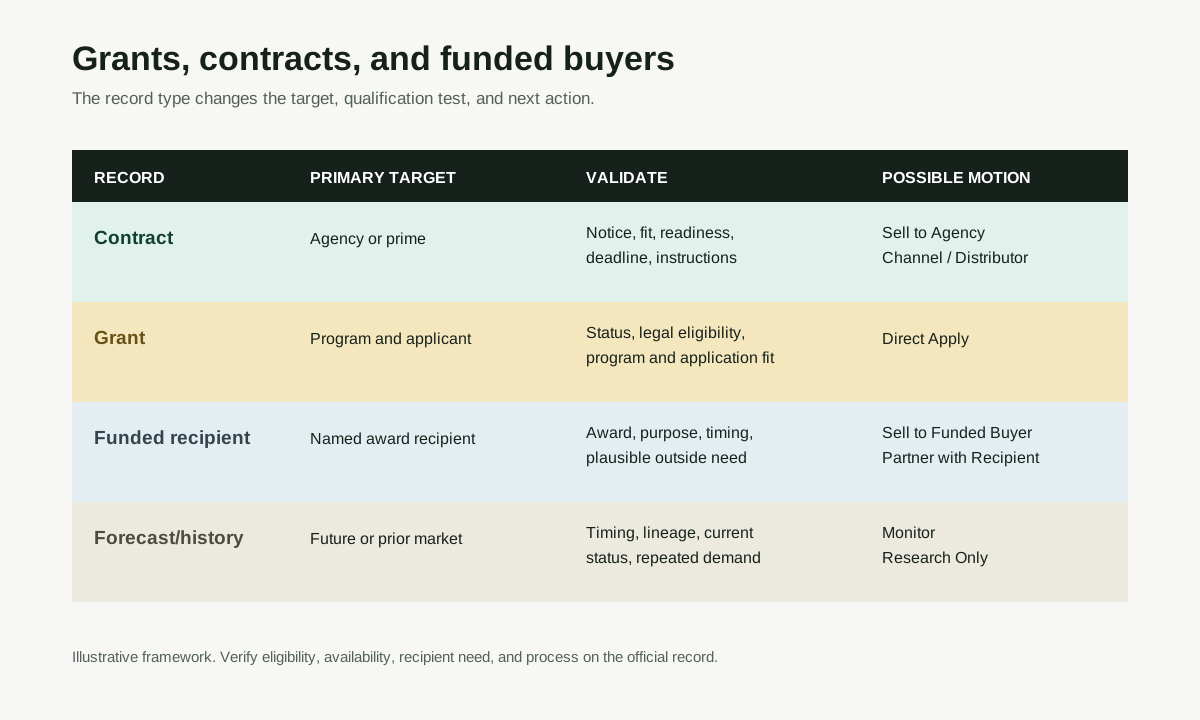
Grants, contracts, and funded buyers require different motions
The same topic can create a direct purchase, an eligible application, an indirect recipient path, or research only depending on the official record.
Open visual full sizeIllustrative decision framework. Eligibility, buyer need, and availability must be verified on each official record. Source: Illustrative Opportunity Scanner decision framework based on SAM.gov, Grants.gov, and USAspending.gov definitions
Sources cited
Put this into the product
Run a free scan to separate direct bids and applications from funded-buyer, recipient-partner, monitoring, and research paths.
Opportunity Scanner classifies the evidence, opens the official route, and lets you start a pursuit with an owner, fit decision, next step, internal due date, and notes.
Scan Your Company WebsiteKeep exploring
Related reads
Opportunity Intelligence
What Is a Public-Sector Opportunity Signal?
Learn how to classify public-sector opportunity signals, reject weak matches, and turn credible evidence into a target and next action.
7 min read
Opportunity Intelligence
What a Public-Sector Opportunity Report Should Include
The fields, evidence, qualification logic, and workflow controls that turn public-sector research into an Opportunity Action Table.
7 min read
Public-Sector Sales
Why Government Spending Is an Overlooked Growth Channel for Businesses
A practical guide to using contracts, awards, grants, recipients, and forecasts as evidence for new public-sector revenue paths.
7 min read