
What Is a Public-Sector Opportunity Signal?
Learn how to classify public-sector opportunity signals, reject weak matches, and turn credible evidence into a target and next action.
Quick answer
The short answer
A public-sector opportunity signal is a sourced external record that indicates a possible revenue, funding, procurement, partnership, policy, workforce, reimbursement, or money-flow opportunity. The word possible matters. A signal is not automatically a lead, open bid, grant, or qualified deal. It becomes useful only after a team verifies what the source proves, identifies the target organization, chooses a revenue motion, and assigns a contact path and next action. This definition prevents public data from becoming an impressive-looking list that nobody can responsibly pursue.
Key takeaways
- A signal must have an official source, a clear evidence type, and enough context to support a business-development decision.
- Active, historical, forecasted, funded-recipient, policy, and research evidence require different labels and actions.
- Qualification should reject weak matches and preserve uncertainty instead of manufacturing urgency.
- The final unit of value is an action row connecting source, target, revenue motion, contact path, and next best action.
Separate the source record from the business interpretation
The source record is what an agency or official system published: a notice, award, forecast, funding opportunity, regulation, budget, plan, recipient, or other documented event. The business interpretation explains why that record may matter to a specific company. Keeping those layers separate makes the reasoning auditable and prevents a generated summary from quietly becoming the source of truth.
For example, SAM.gov may publish a Sources Sought notice. FAR 15.201 explains that an RFI may support planning when the government does not presently intend to award a contract and that responses are not offers. The record can be a meaningful early procurement signal, but it should not be called an open contract. The interpretation may recommend a capability response, monitoring task, or no action depending on fit and instructions.
USAspending may show a prior contract or grant to a named recipient. That proves a federal award record exists and can support historical market research. It does not prove a current buying need. A report should preserve the award type, dates, agency, recipient, amount definition, and caveat before proposing any target or motion.
Use six signal classes
Active opportunity signals have a current response, application, registration, or purchasing path. Examples include a posted solicitation, open grant opportunity, active state or local bid, or official vendor request. These deserve deadline and eligibility review before they enter active pipeline.
Historical money-flow signals show that money moved or was promised previously. USAspending awards, contract histories, grant awards, and official award announcements can reveal buyers, recipients, incumbents, primes, and recurring categories. They support account research and timing analysis, not claims that budget is open now.
Forecast signals describe anticipated activity. Agency procurement forecasts and Grants.gov forecasts can support preparation and monitoring. Grants.gov explicitly says a forecast is planned and may never become an official funding announcement. Forecasts should carry expected timing and a review date, not an artificial close date.
Funded-recipient signals identify organizations positioned to execute publicly funded work. The correct target may be a grantee, prime contractor, university, health provider, workforce board, local government, school system, or nonprofit. The row should verify the recipient and purpose, then assess whether the company has a plausible vendor, channel, or partner role.
Policy and program signals indicate that rules, reimbursement, budgets, mandates, plans, or program design may create demand. Federal Register documents can include proposed rules, final rules, notices, and other materials. A proposed rule belongs in Monitor Policy unless a separate procurement or funding record creates an active route.
Research signals provide relevant context but lack a qualified route. A market-size statistic, closed opportunity, old award, broad agency priority, or assistance listing may justify deeper research. It should not inflate active pipeline.
Score evidence before relevance
Start with source authority and record status. Is the URL official? Is the record current? Does it identify a notice type, award, recipient, program, office, or date? Can another reviewer reproduce the evidence? A strong semantic match from an unofficial summary is weaker than a precise official record.
Then evaluate company fit. Map the record to a real offer, delivery model, geography, buyer problem, and likely requirements. The match should explain why the company could help, not merely repeat shared words. A staffing platform and a construction workforce grant may share the word workforce while supporting very different buyers and services.
Finally evaluate actionability. Name the target and choose one revenue motion: Direct Apply, Sell to Agency, Sell to Funded Buyer, Sell to Award Recipient, Partner with Recipient, Channel or Distributor Motion, Monitor Policy, or Research Only. Identify the official contact, office, portal, recipient role, prime, or manual research task that makes the next action realistic.
Reject signals that cannot survive a disqualifier test
Disqualify an active record when the deadline has passed, eligibility fails, the scope is materially outside the offer, performance conditions are unrealistic, or the source cannot be verified. Disqualify a funded-buyer interpretation when the recipient is not confirmed, the award purpose is unrelated, or no plausible purchasing or partnership role exists.
Defer rather than promote a record when status is ambiguous, the buyer cannot be identified, a forecast lacks enough detail, or policy evidence has not created an operational requirement. Keep the uncertainty in the row. Research Only and Monitor Policy are useful outcomes when they stop the team from sending premature outreach.
Illustrative example: a software company finds a final rule affecting reporting obligations in its market. The source is credible, but the rule alone does not name a buyer or procurement. The row should be Monitor Policy, targeting affected agency or regulated-market research, with a next action to identify implementation guidance and related procurements. No buyer intent or revenue result is assumed.
Translate qualified signals into owned work
A qualified row should contain the source URL, evidence summary, signal class, record status, target, why it matters, revenue motion, contact strategy, next best action, owner, timing, confidence, and disqualifier. The evidence summary should say what the source proves. The why-it-matters field should connect that proof to the company's offer without overstating it.
The contact path depends on the class. Active federal notices route through their instructions and source contacts. Historical awards may route to the agency office, incumbent, or recipient research. Grants may route to the listed program contact for application questions or to recipient monitoring for an indirect motion. Policy signals may route to a docket, program office, compliance owner, or scheduled review rather than sales outreach.
Opportunity Scanner is designed to perform this translation consistently. It does not turn uncertainty into certainty. Its value is preserving the source while making the next decision visible enough for a human owner to accept, revise, defer, or reject.
Opportunity signal classification test
- 1Verify the official source and retrieval date.
- 2Identify the exact record type and current status.
- 3Classify it as active, historical, forecasted, funded-recipient, policy, or research evidence.
- 4Write one sentence describing only what the source proves.
- 5Connect the evidence to a specific existing company offer.
- 6Name the target organization, office, recipient, prime, or partner.
- 7Assign one primary revenue motion.
- 8Select the source-native, official-office, portal, role-based, partner, or research contact path.
- 9Write one next action and one disqualifier.
- 10Reject, defer, monitor, or promote the row without hiding uncertainty.
Charts and visual evidence
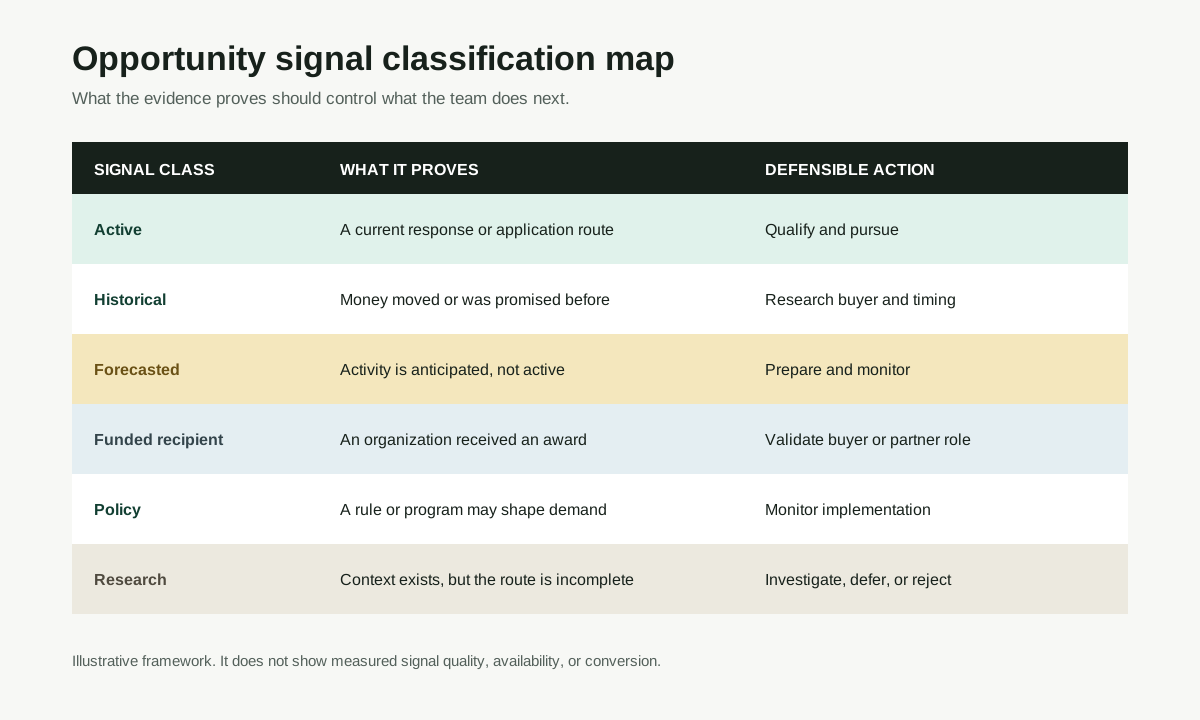
Opportunity signal classification map
Evidence class and timing determine whether the right action is pursuit, account research, preparation, recipient research, monitoring, or rejection.
Open visual full sizeIllustrative classification framework. It does not represent measured signal quality or conversion. Source: Illustrative Opportunity Scanner framework using official source definitions
Sources cited
Put this into the product
Scan your company website to see public-sector records classified into evidence-backed action rows instead of a generic list of search results.
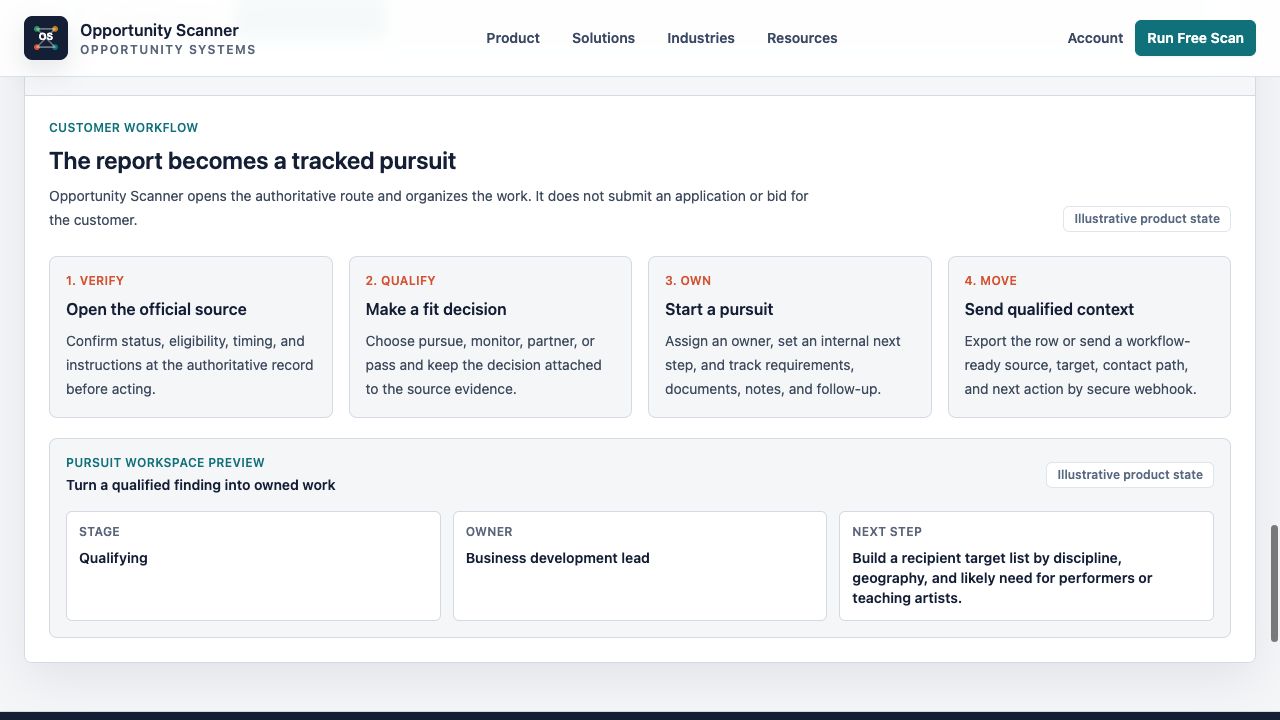
Opportunity Scanner classifies the evidence, opens the official route, and lets you start a pursuit with an owner, fit decision, next step, internal due date, and notes.
Scan Your Company WebsiteKeep exploring
Related reads
Opportunity Intelligence
Grants vs Contracts vs Funded Buyers: What Businesses Should Actually Track
Understand when to apply, bid, sell to an agency, pursue a funded organization, partner with a recipient, or keep researching.
7 min read
Opportunity Intelligence
What a Public-Sector Opportunity Report Should Include
The fields, evidence, qualification logic, and workflow controls that turn public-sector research into an Opportunity Action Table.
7 min read
Public-Sector Sales
Why Government Spending Is an Overlooked Growth Channel for Businesses
A practical guide to using contracts, awards, grants, recipients, and forecasts as evidence for new public-sector revenue paths.
7 min read