
Government Buyer Contact Paths: Who Do You Actually Reach Out To?
Choose the official contact route that fits each public-sector signal before using personal-email enrichment.
Quick answer
The short answer
The question 'Who is the government buyer?' is often too narrow. The right next route may be a contracting officer, notice contact, program office, small-business office, vendor portal, funded recipient, prime contractor, grants contact, or monitoring task. Contact-path quality comes from matching the route to the source record and revenue motion, then respecting the procurement stage.
Key takeaways
- Start with the source-native contact and official response instructions.
- The right contact changes with the revenue motion and procurement stage.
- Enrichment can support validated private targets but should not replace official public routes.
A contact path is a route, not just a person
A useful contact path answers three questions: which organization owns the decision, which official channel governs the interaction, and what should the seller ask or do next? A name and email without those answers can send a relevant opportunity to the wrong person or create outreach that conflicts with procurement instructions.
Start from the evidence. Record the source, status, target, revenue motion, and stage. USAGov maintains official agency websites and contact routes, while Acquisition.gov links to agency forecasts, industry liaisons, small-business offices, and vendor communication plans. Those directories are stronger starting points than an unverified contact database.
Treat the path as structured data: route type, organization, office or role, official URL, source-native contact, restrictions, fallback, confidence, and next action. This makes the row useful even when no individual email is available.
Active notices: follow the record
For a SAM.gov opportunity, inspect the notice type, status, attachments, response method, deadline, and listed contacts. A solicitation may require submission through a portal or to a contracting officer. A Sources Sought notice may request a capability statement in a specific format. An award notice is usually market evidence, not an invitation to pitch the agency contact.
FAR 15.201 encourages early exchanges that improve understanding of requirements and industry capabilities. After a solicitation is released, however, the contracting officer is the focal point for exchanges with potential offerors. Questions that could affect proposal preparation should travel through the stated process so relevant information can be shared fairly.
Do not route sellers to program staff to work around the contracting officer, seek nonpublic evaluation information, or privately negotiate a live requirement. The action row should preserve every communication restriction visible in the source.
Early demand: use offices and public engagement routes
A procurement forecast, draft requirement, industry day, or recurring buying pattern can justify earlier market engagement. The path may be an industry liaison, forecast owner, program office, Office of Small and Disadvantaged Business Utilization, Office of Small Business Programs, or APEX adviser. Research the agency and likely requirement before making contact.
The purpose of early contact is not a generic introduction. Ask a focused question about acquisition timing, vendor engagement, relevant contract vehicles, industry events, or where a capability statement belongs. Share capabilities that map to a public mission need and avoid asking the office to endorse the company or disclose protected information.
If the signal is only historical spending, the next action may be to inspect forecasts or recurring procurements before contacting anyone. A monitoring task can be a complete and correct contact strategy.
Funded recipients and primes need different routes
A grant recipient may buy through its own procurement process, partner through a program team, or pass funds to subrecipients. The official grant record can establish the funding relationship, but it does not prove the recipient needs the seller. Validate the program, organization, and likely function before choosing procurement, partnerships, operations, or program leadership.
A federal prime contractor may have a supplier portal, subcontracting manager, small-business liaison, or published teaming process. SBA's prime-contractor directory is intended for investigating subcontracting possibilities, and SBA recommends following the contractor's own instructions. That route is more useful than sending the same pitch to several executives.
For state, local, school, health-system, or authority targets, start with the entity's official vendor registration, procurement page, bid portal, or department directory. Keep the exact jurisdiction and vendor requirements in the row; there is no single universal local-government route.
Set boundaries for enrichment
Source-native contacts should remain primary when the record supplies them. Enrichment is most defensible for validated private recipients, primes, partners, distributors, and vendors when the team knows which function it needs. Record the provider, verification date, confidence, and suppression state. Do not enrich every row merely because the feature is available.
Avoid replacing an agency office with a guessed personal email, enriching individuals unrelated to the motion, or collecting more personal data than the next action requires. If the official source prohibits solicitation or requires portal communication, that instruction controls the path.
Every path needs a fallback: official inbox, supplier form, switchboard, agency directory, portal registration, event, APEX consultation, manual research task, or monitor date. A no-email result can still be actionable when the organizational route is clear.
Write route-aware outreach and ownership
The CRM note should explain why this route was selected, what the source proves, what remains an inference, and what question the seller should ask. For a contracting contact, the action may be a process clarification. For a recipient, it may be confirming who handles vendor inquiries. For a prime, it may be completing supplier registration before requesting a conversation.
An illustrative row might preserve a Sources Sought notice, assign Sell to Agency, route to the published notice contact, and task the owner with reviewing attachments before drafting a capability response. Another might preserve a verified grant award, assign Partner with Recipient, and route research to the recipient's public program page. Neither illustration assumes a response or outcome.
Commercial outreach must remain truthful and compliant. FTC guidance says business-to-business commercial email is covered by CAN-SPAM. Use accurate identity and subject lines, include the required address and opt-out, honor suppression, and stop when the organization requests it.
Review paths as living records. A notice amendment can change the contact or submission route, a forecast can become a solicitation, and a recipient can publish a supplier process after an award announcement. Store the last-verified date and trigger a new source check before a seller acts on an older row. This small control keeps a once-correct contact strategy from becoming misleading.
Route quality can be reviewed without inventing sales benchmarks. Track whether the official path was verified, whether the owner completed the prescribed action, whether the organization redirected the inquiry, and why a route was closed. Those observations improve future routing while keeping replies, meetings, and revenue separate from the report's factual claims.
Contact-path decision checklist
- 1Identify the source, record type, status, and procurement stage.
- 2Select the revenue motion before searching for a person.
- 3Preserve the source-native contact and response instructions.
- 4Check the agency, recipient, prime, or local entity's official directory or portal.
- 5Use the contracting officer after solicitation release.
- 6Use early-market offices only with a researched, stage-appropriate question.
- 7Enrich validated private targets only when the relevant function is known.
- 8Record restrictions, confidence, fallback route, owner, and next action.
- 9Honor opt-outs, supplier instructions, and communication boundaries.
Charts and visual evidence
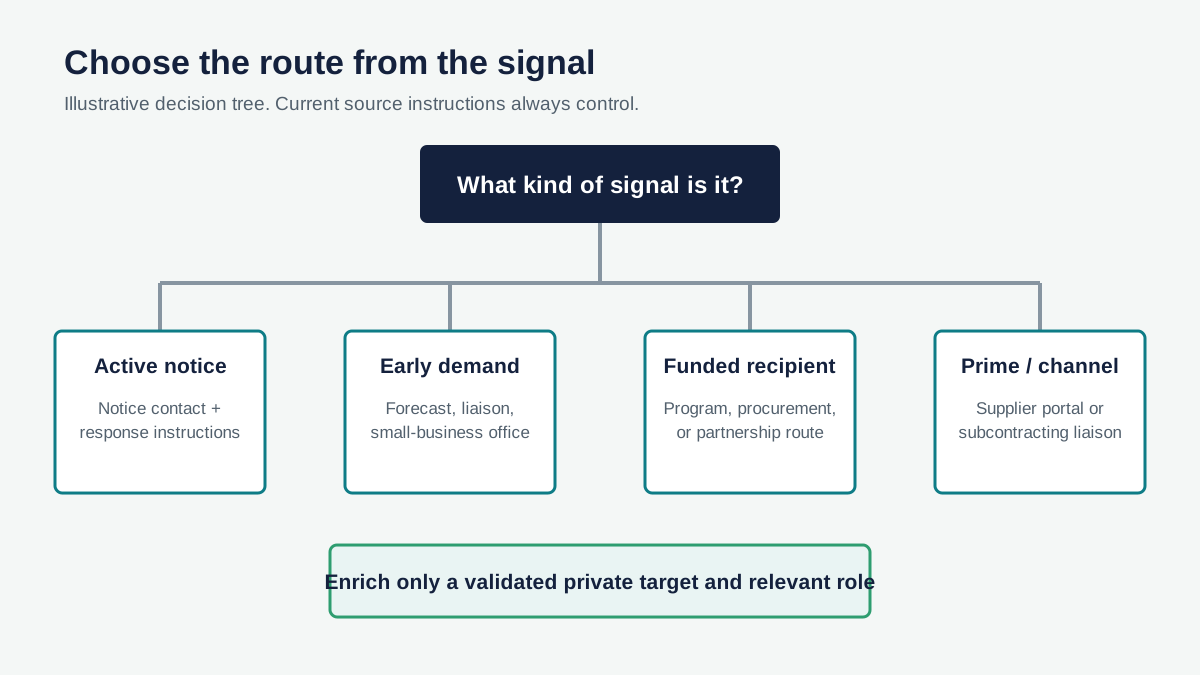
Illustrative contact-path decision tree
The source type and revenue motion determine the official route before enrichment begins.
Open visual full sizeIllustrative route framework. Always follow the current source record and procurement instructions. Source: Illustrative Opportunity Scanner framework informed by SAM.gov, FAR, Acquisition.gov, USAGov, SBA, and FTC guidance; no measured claim.
Sources cited
Put this into the product
Run a scan to get a source-backed contact strategy and next action for every qualified signal.
Opportunity Scanner classifies the evidence, opens the official route, and lets you start a pursuit with an owner, fit decision, next step, internal due date, and notes.
Scan Your Company WebsiteKeep exploring
Related reads
Public-Sector Sales
Why Government Spending Is an Overlooked Growth Channel for Businesses
A practical guide to using contracts, awards, grants, recipients, and forecasts as evidence for new public-sector revenue paths.
7 min read
Government Contracts
Can My Business Sell to the Government? A Practical First Check
Use this readiness assessment to decide whether direct agency sales, subcontracting, funded buyers, partnerships, or monitoring fit your business.
6 min read
Opportunity Intelligence
What Is a Public-Sector Opportunity Signal?
Learn how to classify public-sector opportunity signals, reject weak matches, and turn credible evidence into a target and next action.
7 min read