
How to Find Funded Buyers Before You Start Cold Outreach
Use verified public-money evidence to identify and qualify funded buyers before outreach, without confusing past awards with open budget.
Quick answer
The short answer
Cold outreach usually begins with firmographics and a guessed pain point. Funded-buyer research starts with a stronger question: which organizations received public money for work adjacent to what your company sells, and what does that record actually justify doing? The answer may be outreach, partner research, subcontracting, monitoring, or no action. This guide shows how to follow the money while keeping the evidence, caveats, and contact route intact.
Key takeaways
- A recipient record is market evidence, not proof of available budget or buying intent.
- Validate the award, organization, funded purpose, timing, and downstream need before enrichment.
- Outreach should cite the public context accurately and offer relevant help without implying an inside relationship.
Start with the award, not the email address
USAspending defines a recipient as a company, organization, individual, or government entity that receives federal funding. Recipient profiles can show award trends, agencies, award types, and category rankings. That makes them useful for account discovery, but the recipient label alone says nothing about whether your offer fits or whether funds remain available.
Begin with an official award or assistance record. Capture the recipient's legal name, parent and child relationships, UEI when available, awarding and funding agencies, award type, period of performance, place of performance, description, obligations or outlays, and the source retrieval date. USAspending cautions that spending concepts and reporting fields differ, so do not casually translate an obligation into cash in the bank.
The first action is verification. Confirm that the recipient is the organization you think it is, the award supports a relevant program, the timing is meaningful, and the company could plausibly contribute. Only then should the row become a target account.
Separate four funded-buyer situations
A contract recipient is often a prime or incumbent vendor. The practical motion may be subcontracting, channel partnership, competitive research, or future agency pursuit. SBA's directory of primes with subcontracting plans provides fields such as agency, PSC, NAICS, place of performance, contract period, and value specifically to support investigation of subcontracting possibilities.
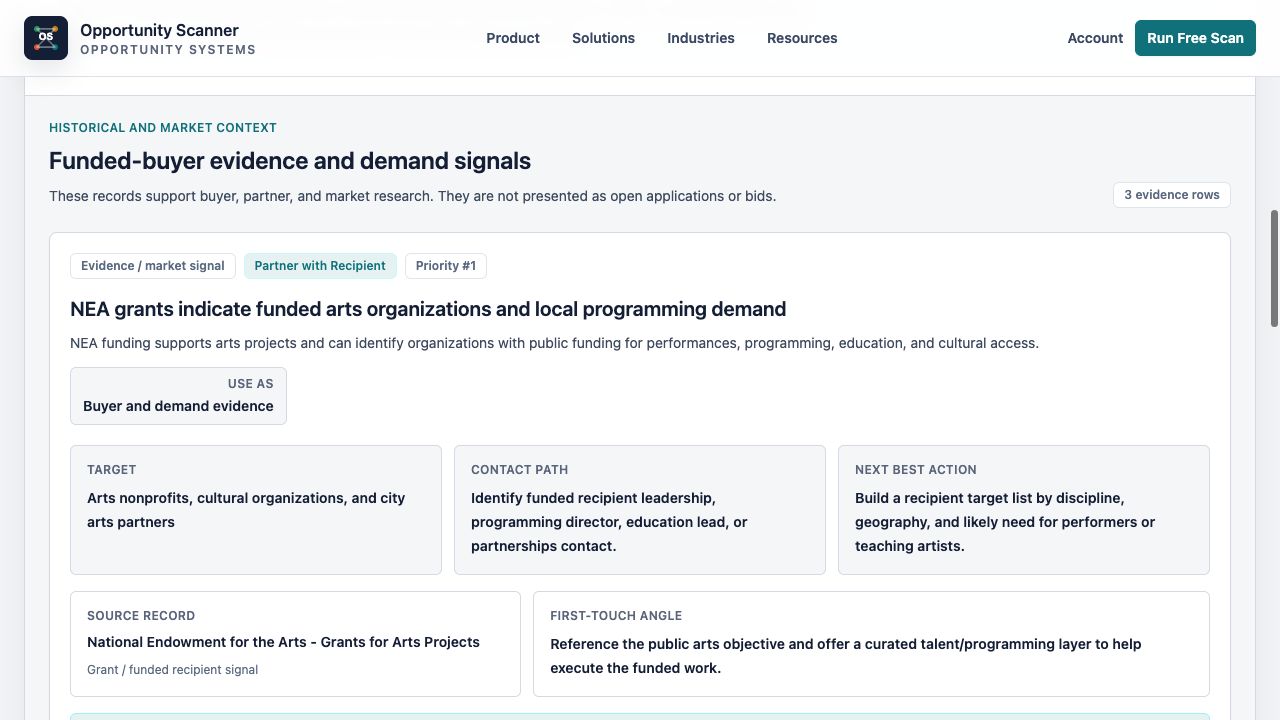
A grant or cooperative-agreement recipient may be a state, local government, nonprofit, university, health provider, workforce board, or other program operator. The commercial company may not have been eligible to apply directly, but it may be able to sell to or partner with the recipient. That motion becomes credible only after the recipient and program purpose are verified.
A loan, direct-payment, or other assistance record can signal market activity without creating a straightforward vendor path. A subaward can identify a more local implementing entity, but subaward data has its own coverage and quality caveats. Keep award type and tier visible so sellers do not treat every money-flow record as the same commercial event.
Qualify the downstream need
Read the award description and supporting program materials, then translate the funded purpose into likely operational needs. A workforce award may create demand for instruction, participant recruitment, software, evaluation, or employer partnerships. A healthcare award may create demand for equipment, outreach, data systems, or clinical support. These are hypotheses to validate, not claims that the recipient is shopping.
Score fit across offer relevance, recipient type, program stage, geography, delivery capacity, procurement route, and evidence quality. Check the period of performance and recent transactions. A large historical award that ended years ago may still reveal a segment, but it should not trigger time-sensitive outreach. A recent award announcement may justify monitoring before vendor procurement begins.
Disqualify duplicate legal entities, pass-through recipients with no operational role, vague descriptions with no adjacent need, incompatible geography, expired programs, and records where the company cannot deliver. Redirect a row when the agency, prime, subrecipient, or program office is a more credible target than the named recipient.
Choose the route before enrichment
Look for source-native routes first: the recipient's official website, program page, procurement or supplier portal, award announcement, public staff directory, or published partnership process. For prime contractors, follow the company's official subcontractor instructions. For a government recipient, use the public procurement or program-office route rather than attempting to enrich an individual civil servant.
Enrichment is appropriate after a private organization has been validated and the relevant function is clear. Search for roles such as program operations, partnerships, procurement, implementation, or business development based on the motion. Record the source, verification date, and confidence. Do not let a guessed personal email overwrite an official route.
The contact path should survive even if enrichment returns nothing. A supplier registration page, program inbox, published phone number, prime-contractor form, or manual research task can be the correct next step. Missing personal data is not the same as missing actionability.
Write outreach from evidence, not assumption
A useful message names the public record accurately, explains the narrow relevance of the company's offer, and asks a route-validating question. It should not say the recipient has budget available, needs a vendor, or was selected as a customer. It should not imply access to private information or an endorsement by the awarding agency.
An illustrative message might say that the team reviewed a publicly listed award related to workforce training, works with organizations on a specific delivery problem, and wants to confirm whether vendor or partner inquiries are handled by the recipient's program or procurement team. This example assumes no response, meeting, buying process, or outcome.
Commercial email still needs compliance. FTC guidance says CAN-SPAM applies to business-to-business messages and requires accurate headers, non-deceptive subjects, a postal address, and a working opt-out. Relevance does not remove those obligations. Keep suppression records and avoid repeated outreach when the source or recipient says not to solicit.
Create a funded-buyer action row
The row should contain the award identifier and URL, recipient and parent, awarding agency, award type, funded purpose, period of performance, evidence summary, caveat, hypothesized downstream need, revenue motion, contact route, outreach angle, owner, next action, and disqualifier. Preserve the difference between verified source facts and commercial inference.
A contract recipient could become Channel or Distributor Motion with a next step to review the prime's supplier requirements. A nonprofit assistance recipient could become Sell to Funded Buyer with a next step to validate procurement. A university award could become Partner with Recipient when the company's capability complements the research or delivery plan. If no downstream need can be supported, keep the row Research Only.
Measure workflow quality first: verified recipients, qualified routes, completed actions, and reasons for rejection. Do not claim reply, meeting, or revenue rates without measured product data. The point of funded-buyer intelligence is to improve the reason for outreach and the path to the right organization, not to manufacture intent.
Recheck the public record before every material follow-up. Awards can receive new transactions, recipient naming can change, and program pages can clarify implementation roles. Update the evidence date and outreach angle when the facts change. If the original premise no longer holds, close or redirect the row instead of preserving a stale narrative because contact research has already been completed.
Funded-buyer validation checklist
- 1Open the official award record and record its retrieval date.
- 2Confirm the recipient, parent relationship, UEI, award type, agency, and place of performance.
- 3Read the funded purpose and period of performance.
- 4Separate verified facts from hypothesized downstream needs.
- 5Select Sell to Funded Buyer, Sell to Award Recipient, Partner with Recipient, Channel Motion, or Research Only.
- 6Find the recipient's official program, procurement, supplier, or partnership route.
- 7Use enrichment only for a validated private organization and relevant role.
- 8Write outreach that cites the public context without claiming available budget or intent.
- 9Assign an owner, next action, follow-up rule, and disqualifier.
Charts and visual evidence
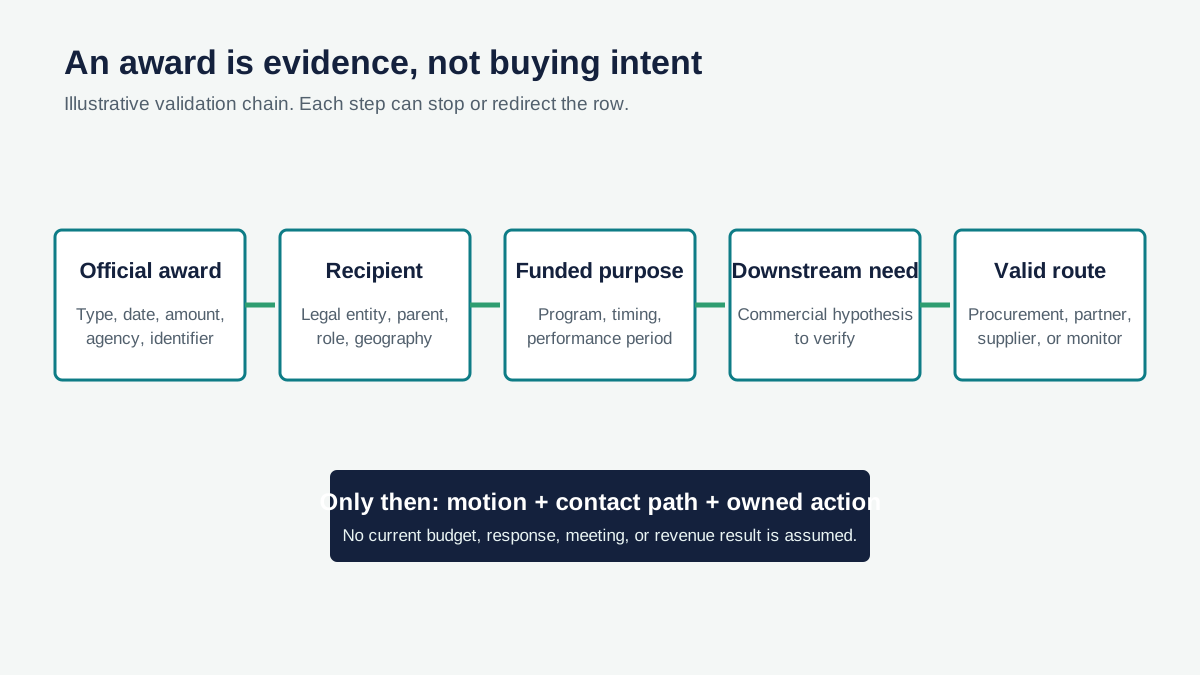
Illustrative funded-buyer validation chain
Award evidence becomes outreach only after recipient, purpose, need, motion, and route are validated.
Open visual full sizeIllustrative validation framework. An award is not proof of current budget or buying intent. Source: Illustrative Opportunity Scanner framework informed by USAspending, SBA, Grants.gov, and FTC guidance; no measured outcome claim.
Sources cited
Put this into the product
Scan a company website to find funded-buyer evidence, appropriate revenue motions, and route-specific next actions.
Opportunity Scanner classifies the evidence, opens the official route, and lets you start a pursuit with an owner, fit decision, next step, internal due date, and notes.
Scan Your Company WebsiteKeep exploring
Related reads
Public-Sector Sales
Why Government Spending Is an Overlooked Growth Channel for Businesses
A practical guide to using contracts, awards, grants, recipients, and forecasts as evidence for new public-sector revenue paths.
7 min read
Government Contracts
Can My Business Sell to the Government? A Practical First Check
Use this readiness assessment to decide whether direct agency sales, subcontracting, funded buyers, partnerships, or monitoring fit your business.
6 min read
Opportunity Intelligence
What Is a Public-Sector Opportunity Signal?
Learn how to classify public-sector opportunity signals, reject weak matches, and turn credible evidence into a target and next action.
7 min read